April 9 – 10
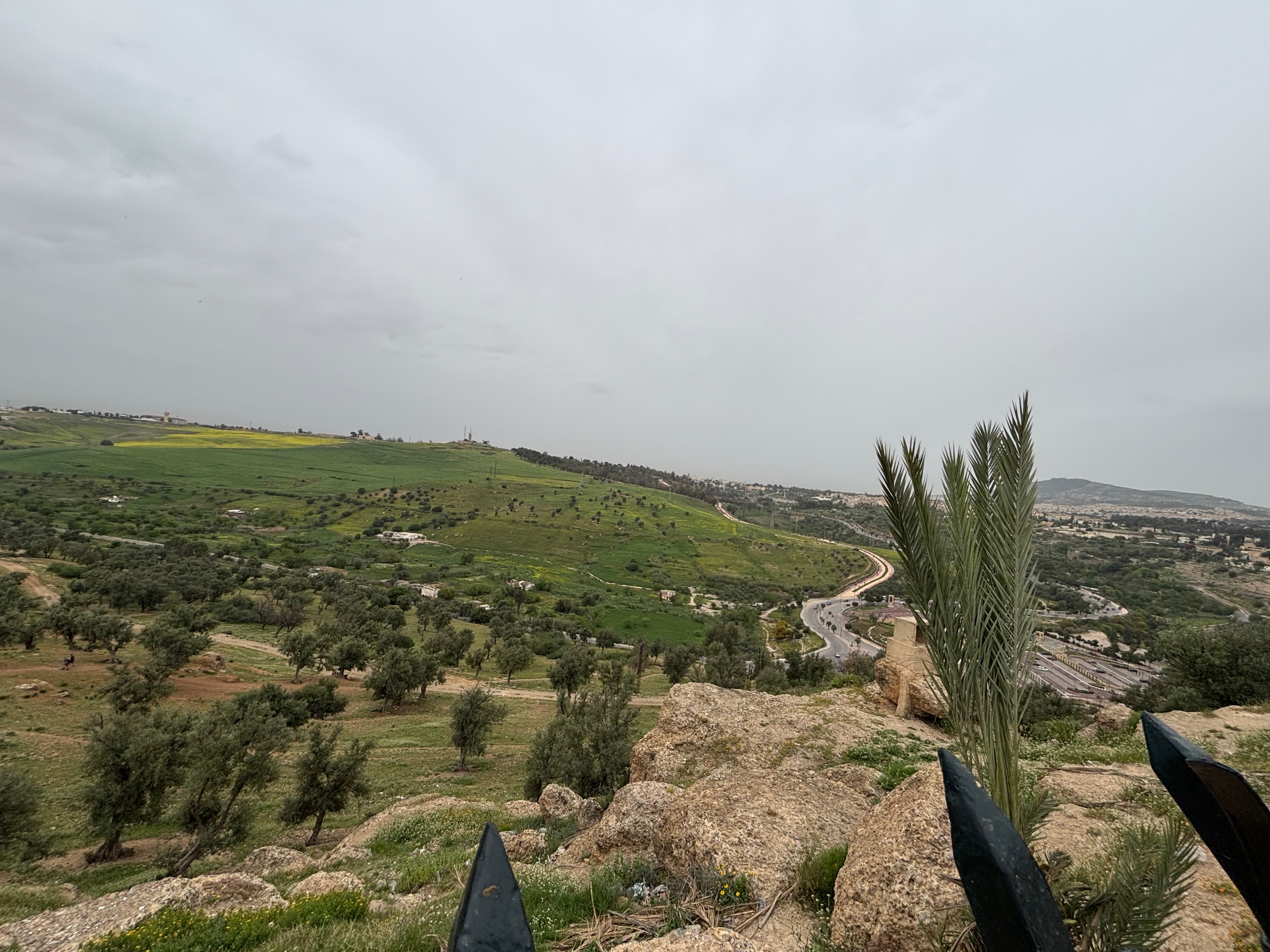
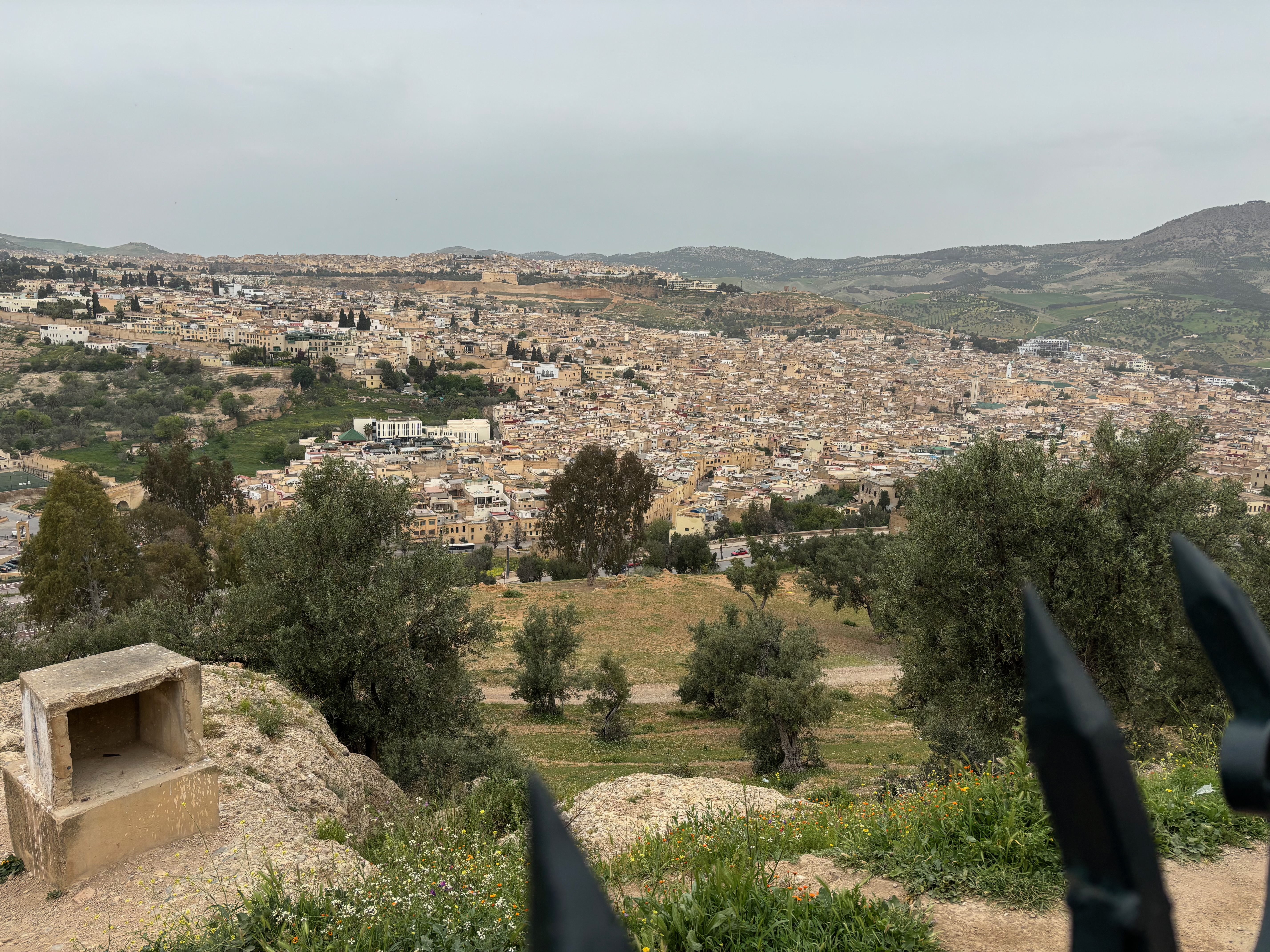
We’d met our guide for the medina at the Bab Bou Jeloud City Gate and he led us through the street that comprised the Jewish quarter where we climbed back into the van for a ride out to the Art Naji Pottery and Tile shop, first stopping at an overlook that provided a nice view of the city and its walls. Back in the van we drove back down the hill into town to the shop, our opportunity to witness local craftsmen making all kinds of pottery and tiles that would have many uses, including wrought iron furniture.
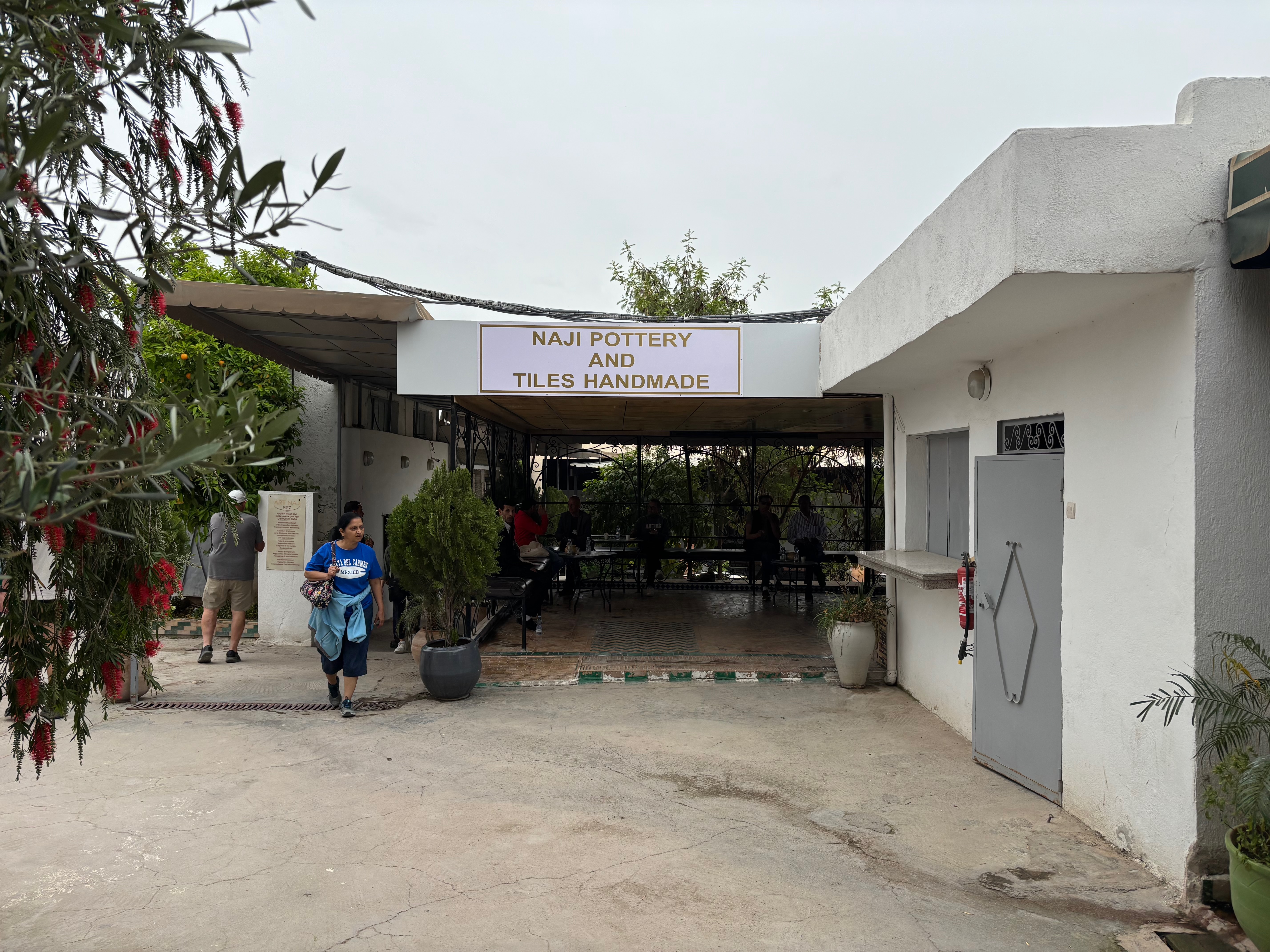
These folks produce beautiful products but one of the main things I came away with, and this would be reinforced throughout the day, was how monotonously dull and repetitive much of the work is and for some, how uncomfortable the working conditions might be. Our first stop was the concrete tubs where the raw clay is cured and then pulled out for use in the making of the pottery and tiles.
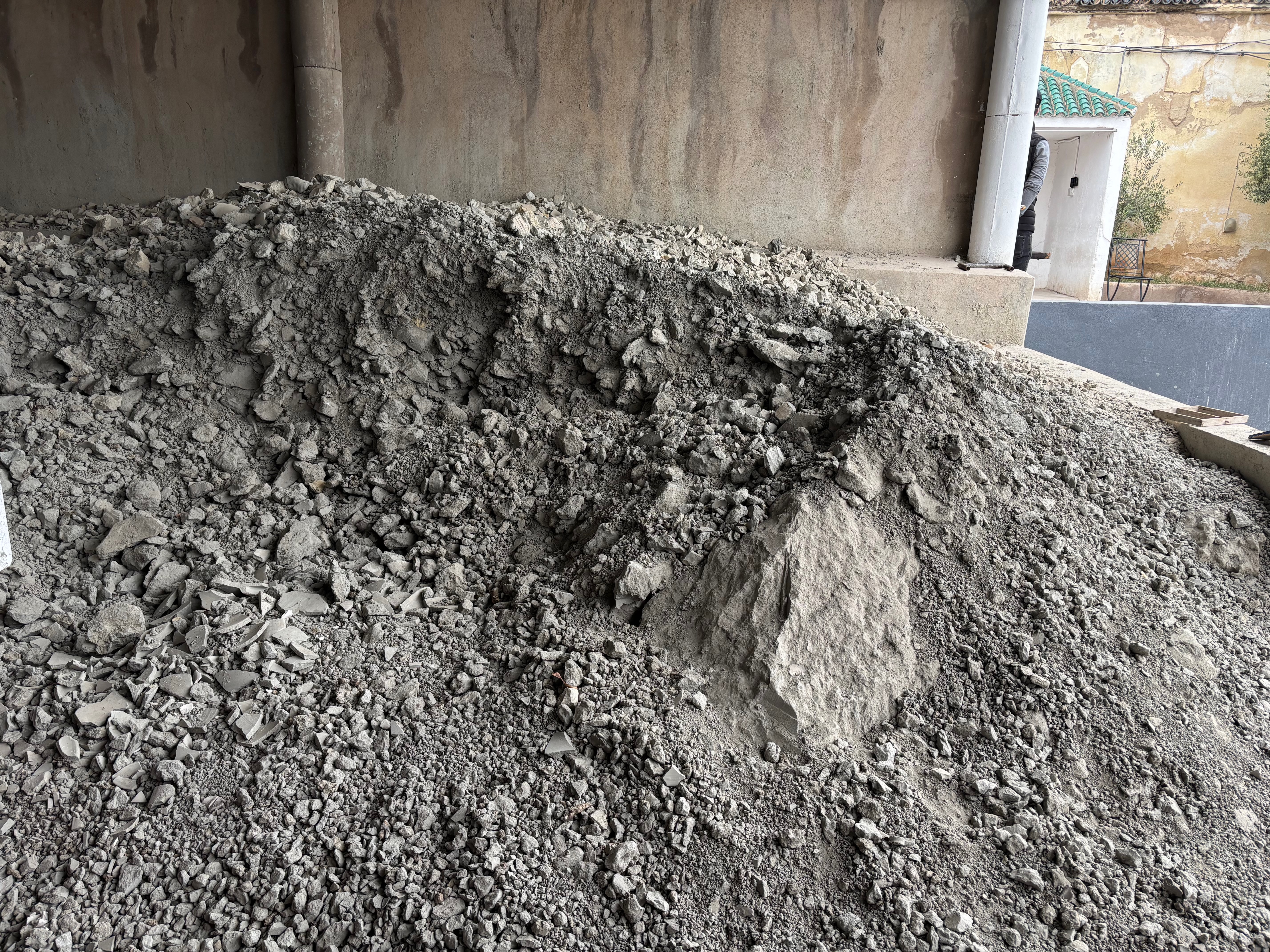


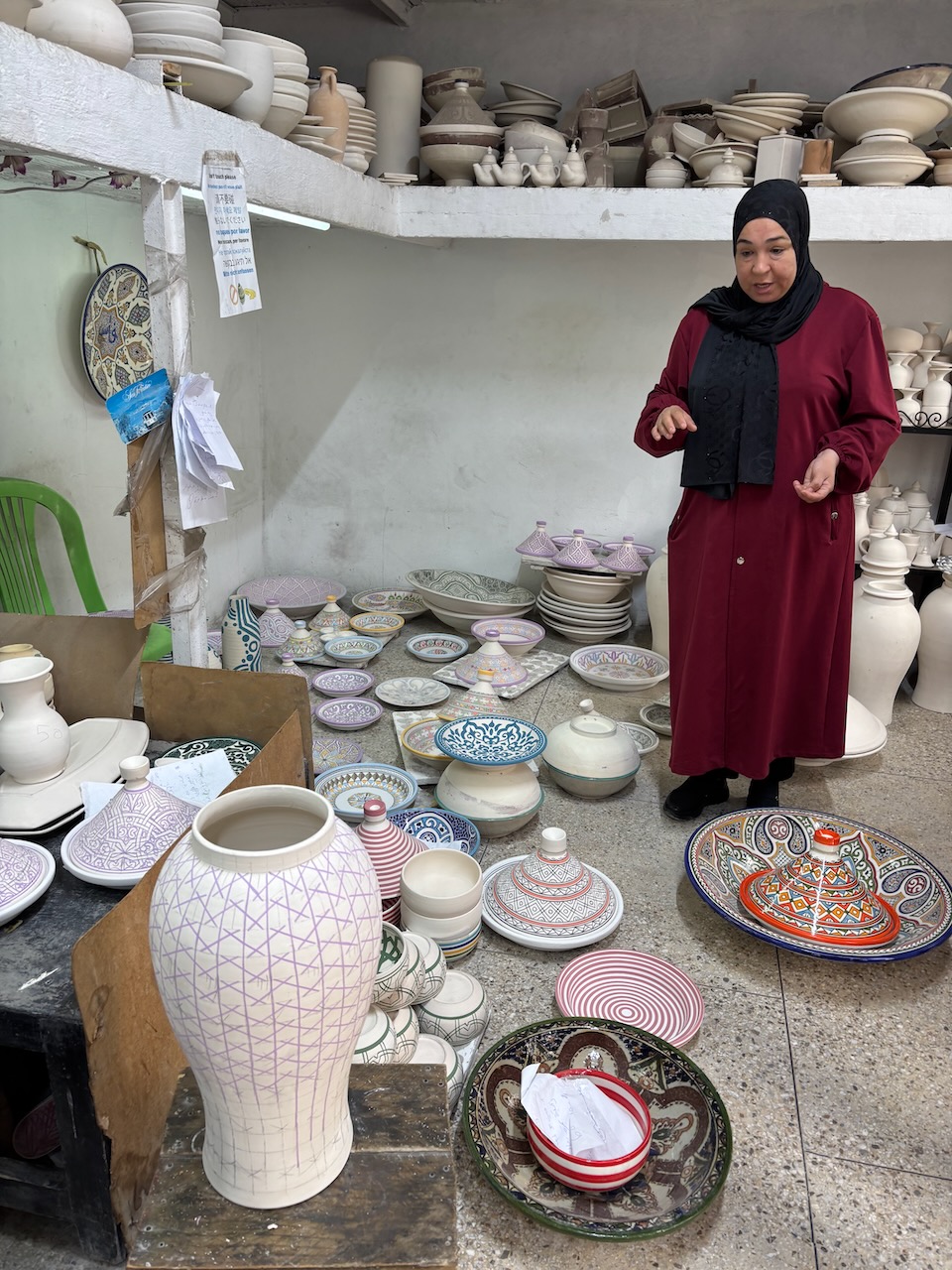
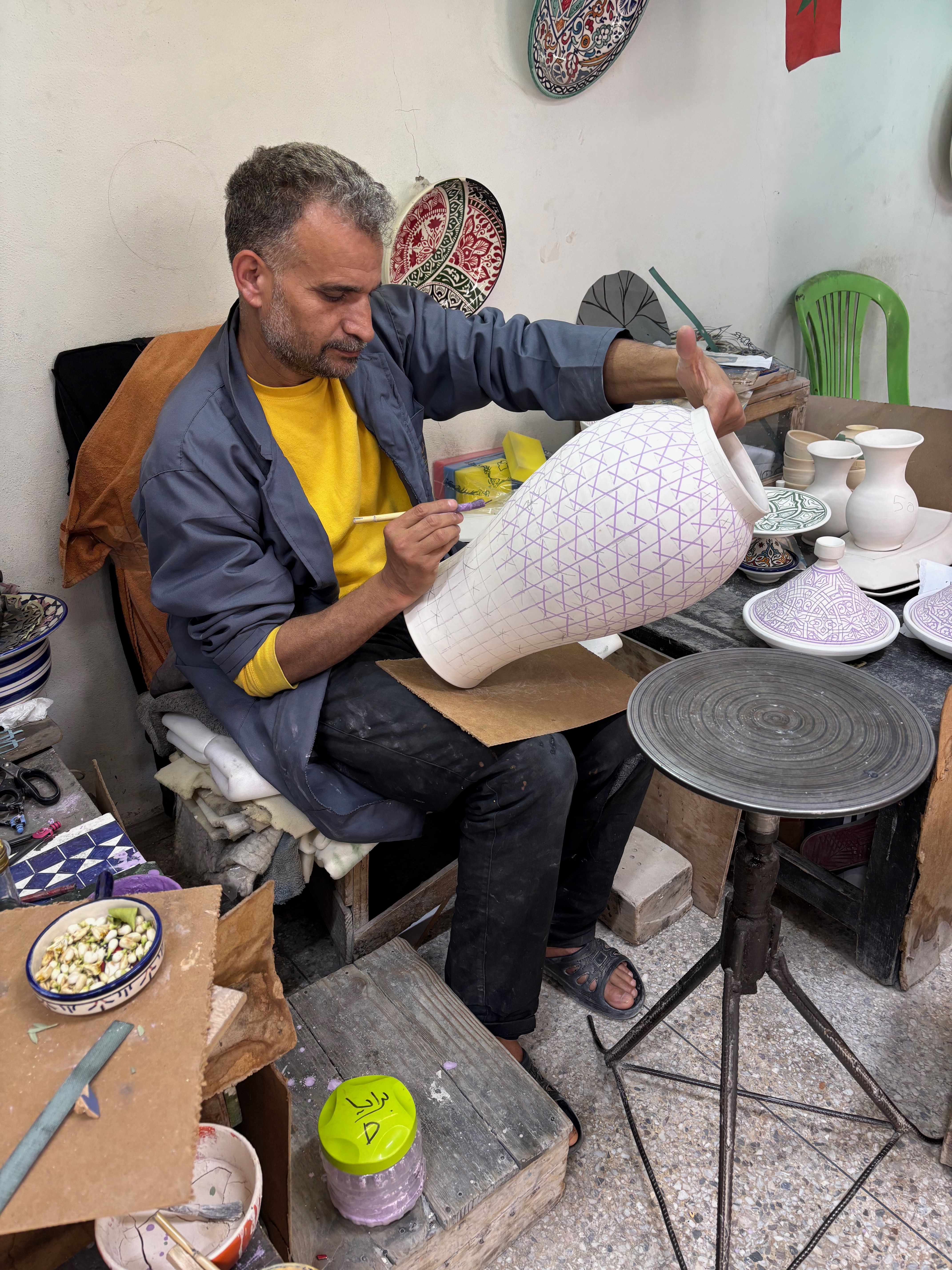
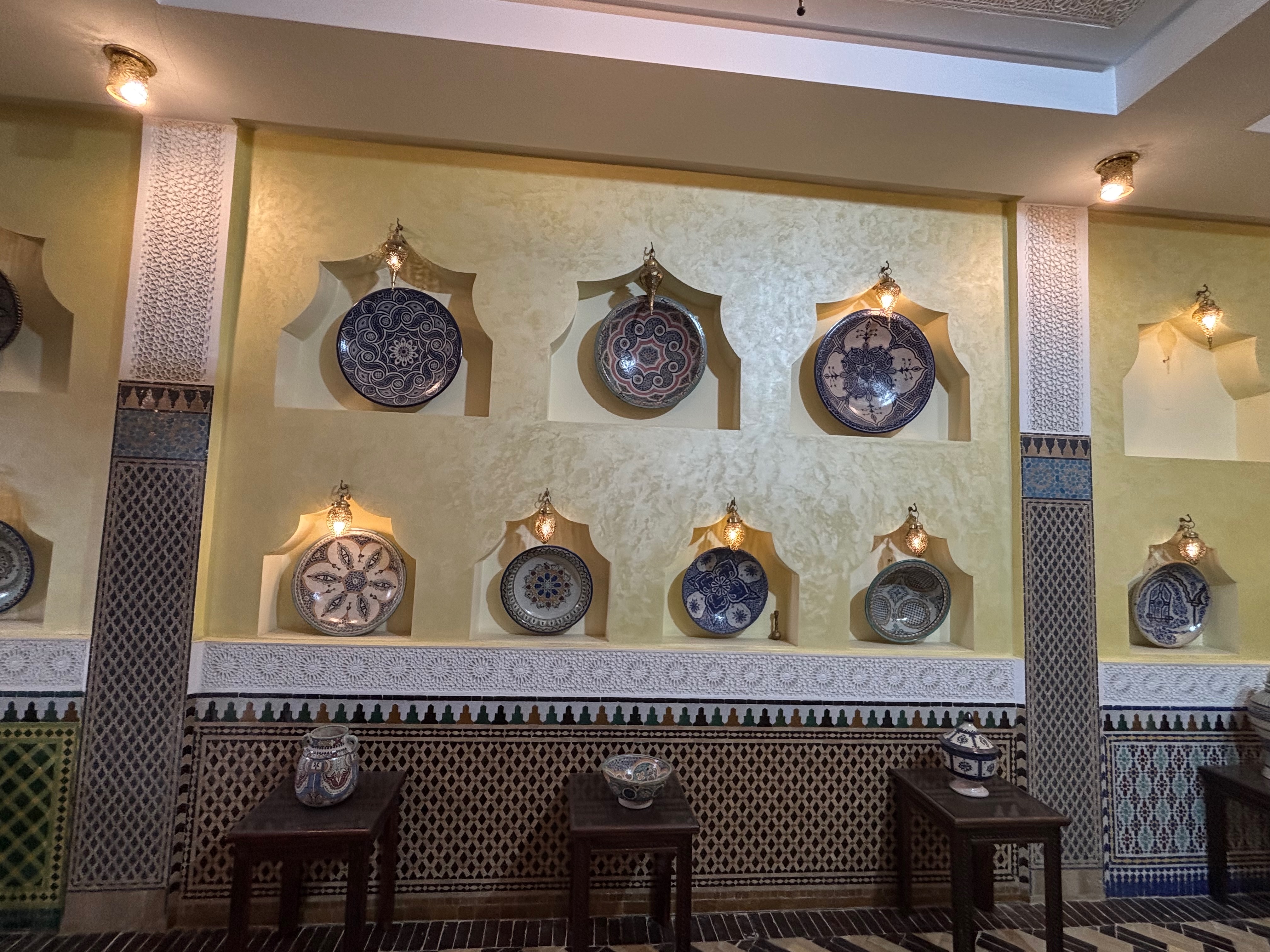
Our next stop was the pottery room, where we observed men and women in the process of either forming pots, urns, plates and tagine or engaged in decorating them. In particular one fellow was creating an intricate geometric pattern without the aid of a stencil, that is completely freehanded.

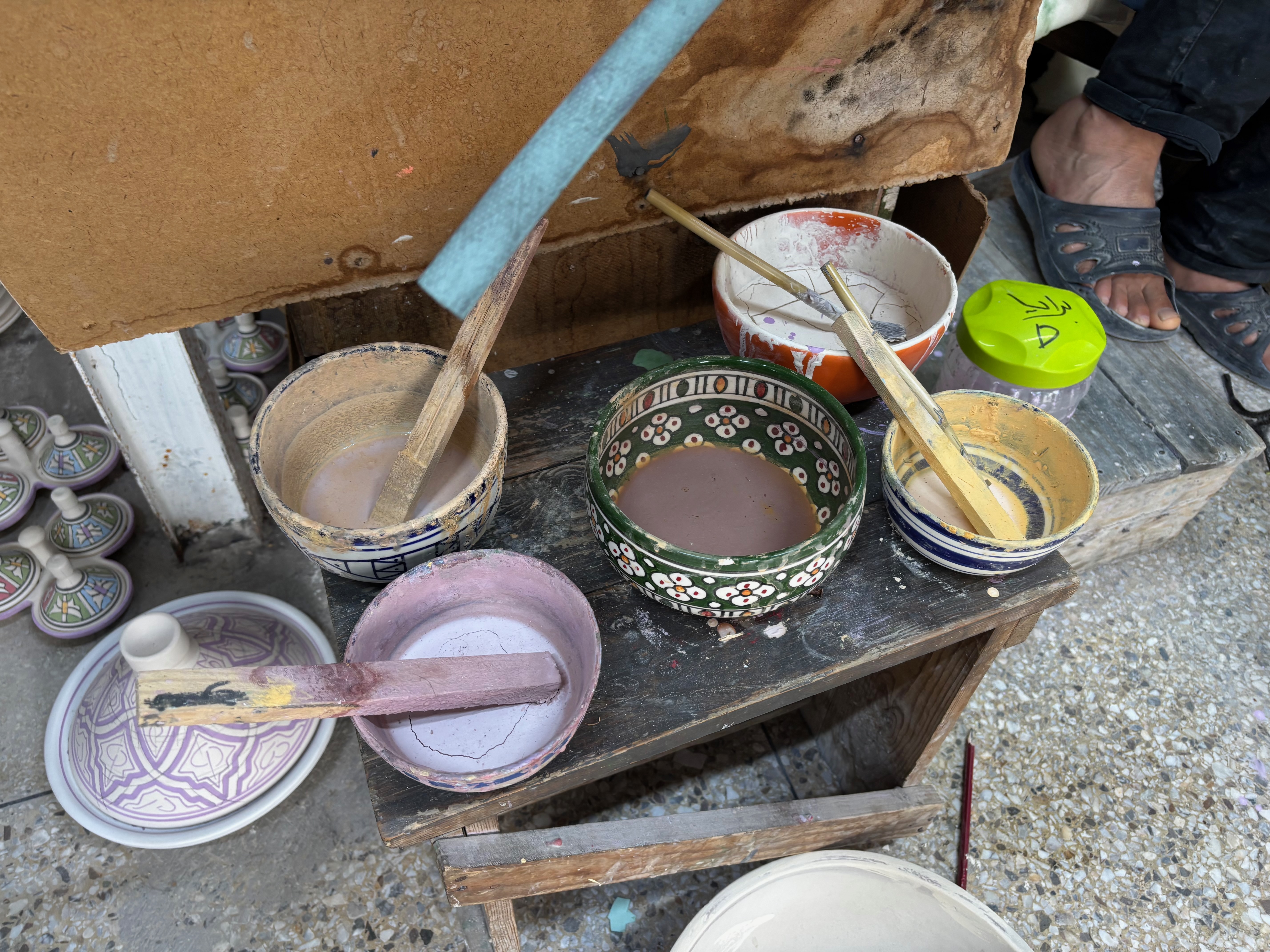
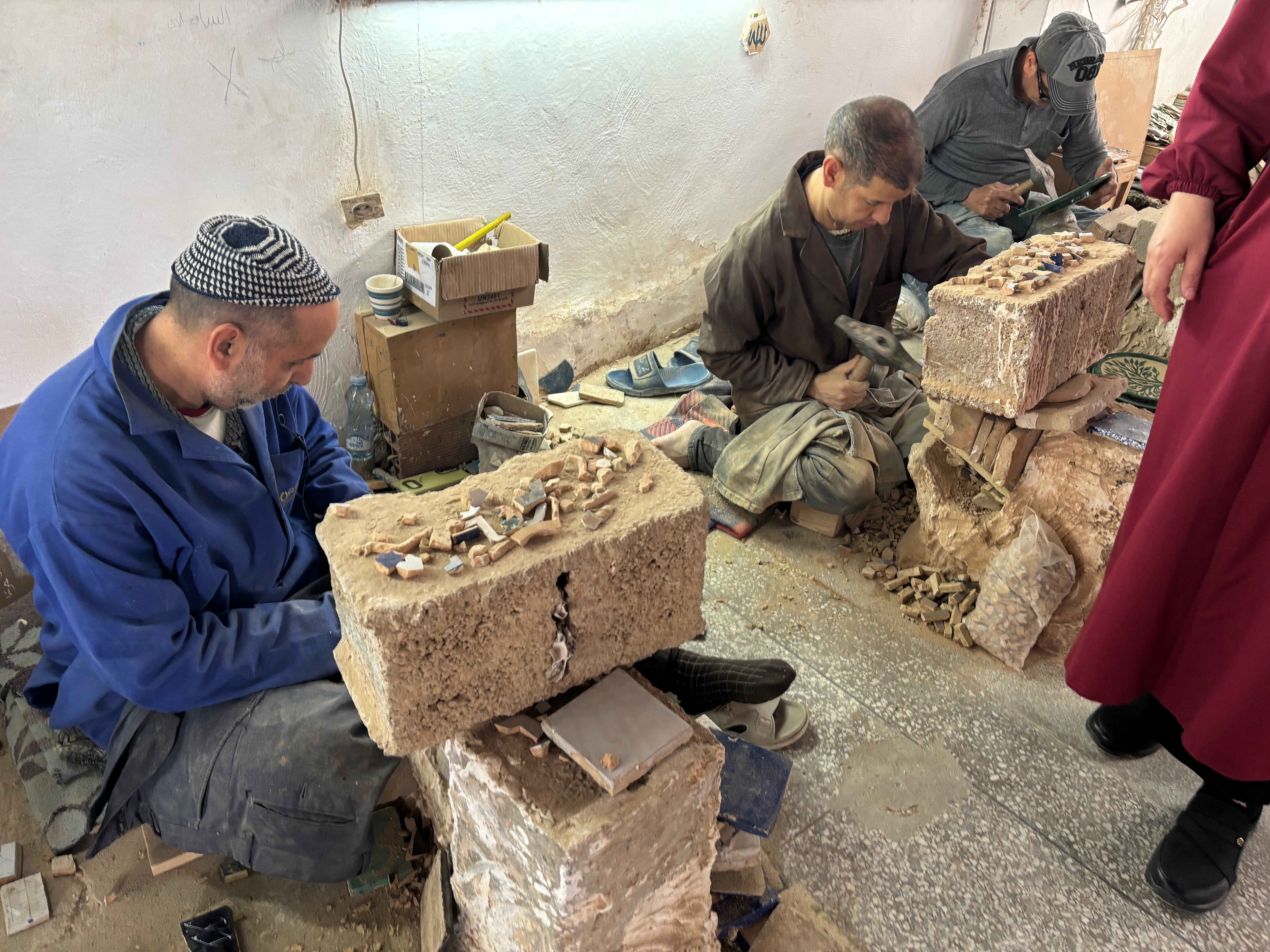
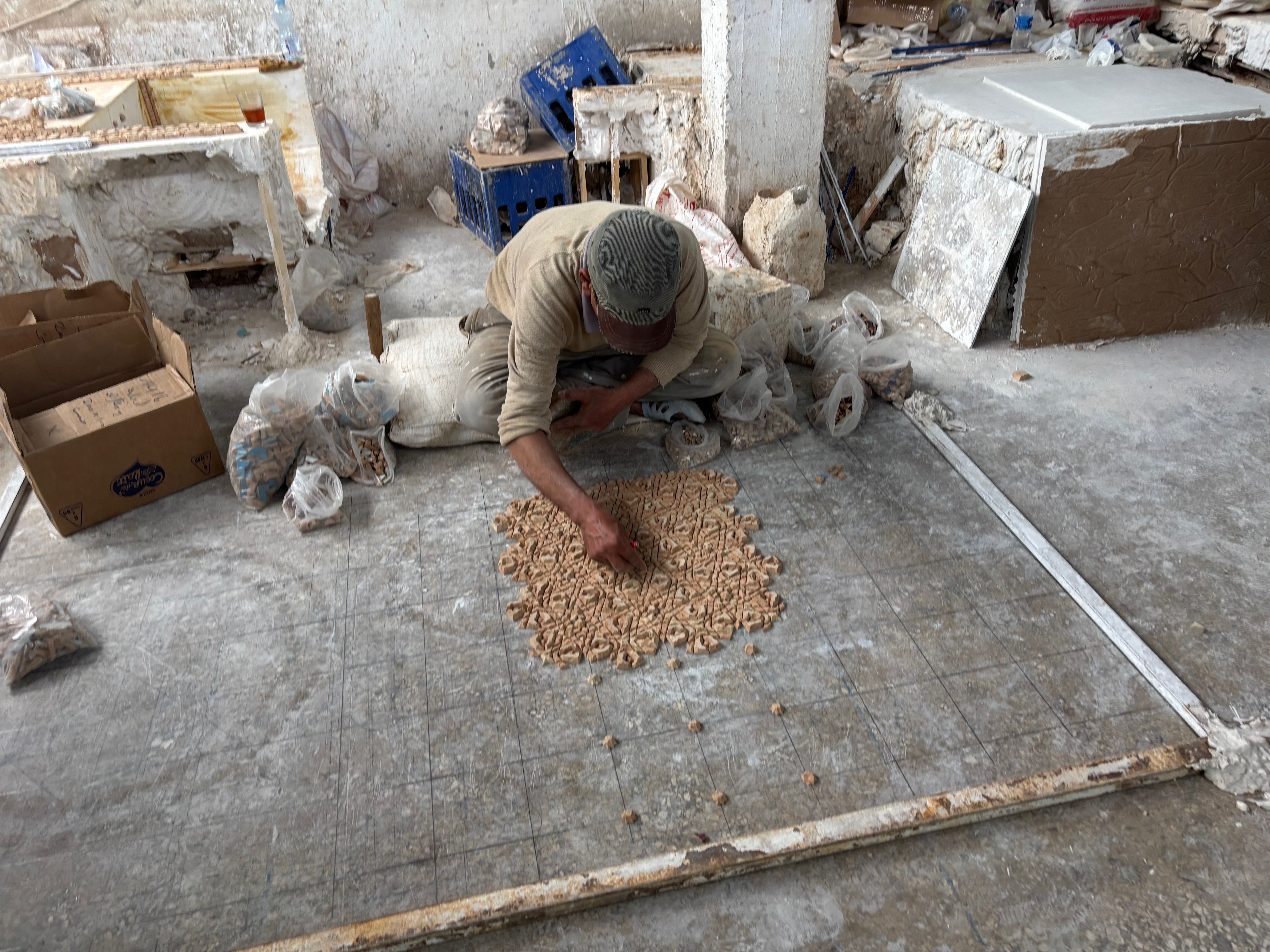
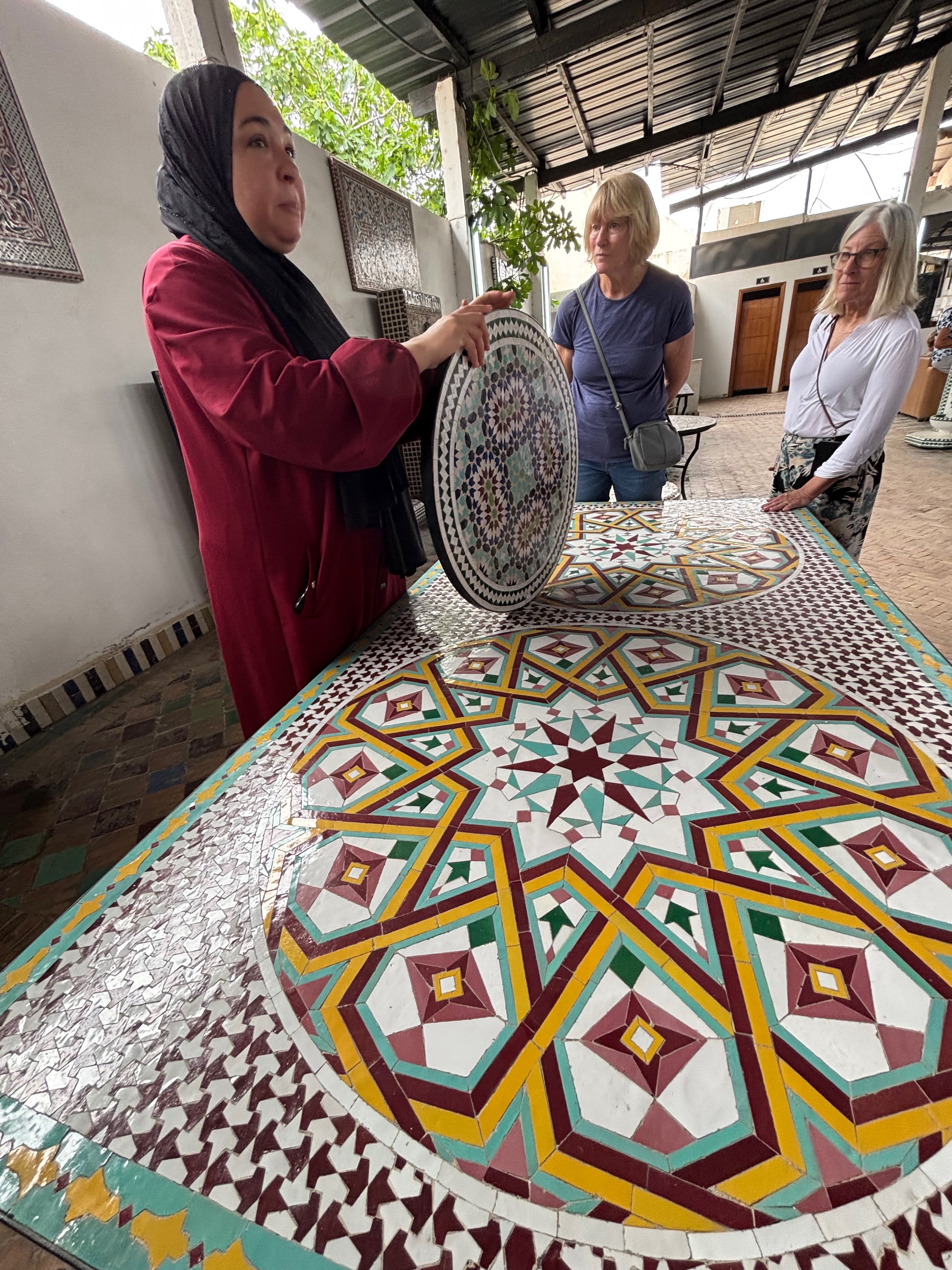
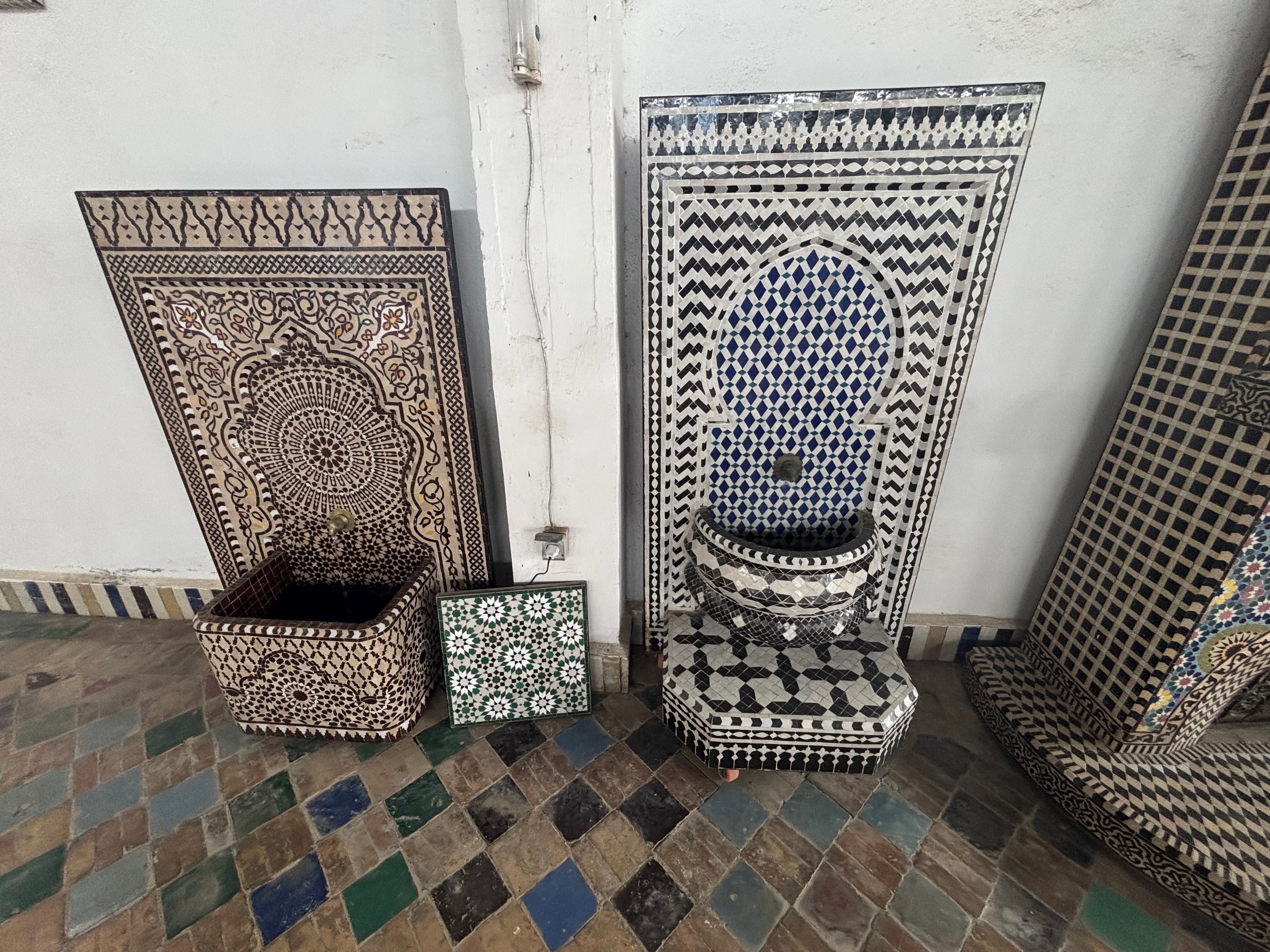
We stepped outside to watch three men performing what seemed to be the most monotonous and repetitive work imaginable, that is chipping away at colored pieces of tile to shape them to the size needed to be placed into the tables tops and fountains we’d watch being assembled later in our tour of the facility. Next, we observed a lone craftsman putting tiles into place in order to create a round tabletop. The amazing thing about this process is that he does it upside down, that is he can’t see the pattern he is creating as he works, but must do so from memory. It is like watching a magic act unfold.
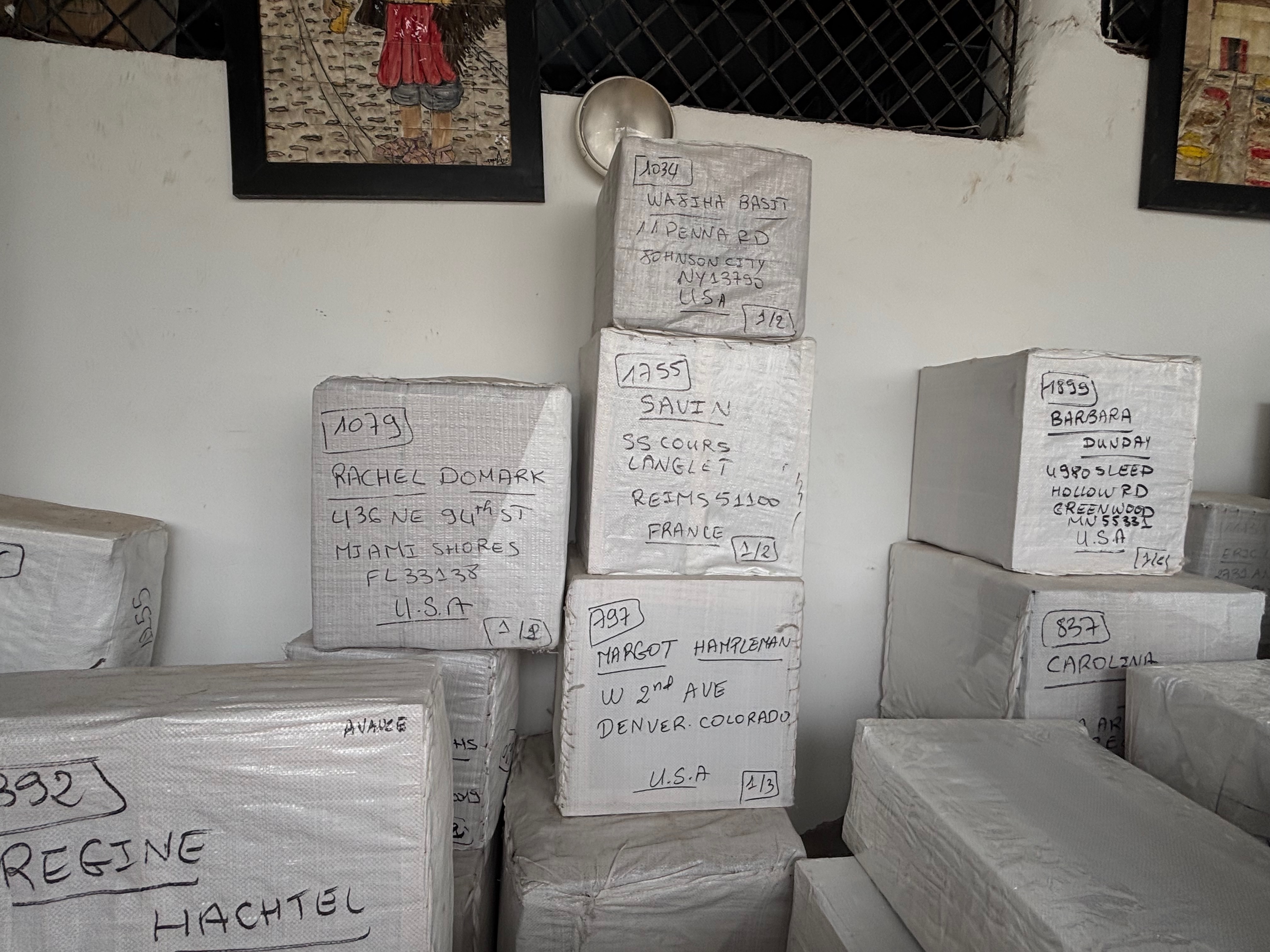
Our last stop here, as it is with all stops of this nature was the large gift shop, stacked with multiple levels of product, all quite enticing but not really needing anything of the nature of what was offered, we all passed on buying. On our way out we passed by a women entering order information into a computer and then stacks of packaged product ready to be shipped out.

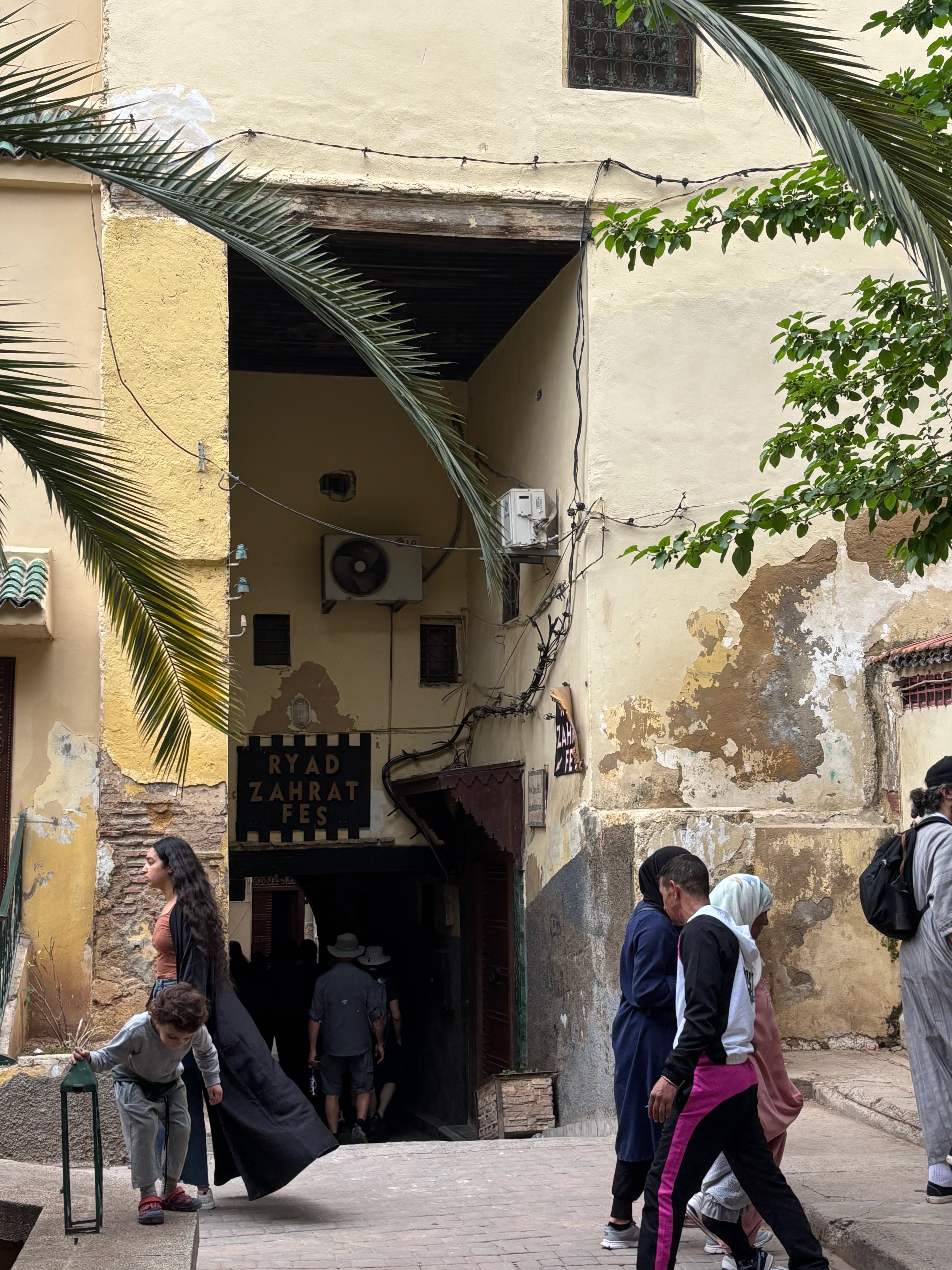
Back in the van, we drove a short distance and parked within walking distance of a square that led to the maze of streets that would be our home for the next few hours. The historic city of Fez consists of Fes el-Bali, the original city on both shores of the Oued Fes (River of Fez), and the smaller Fez Jdid, founded on higher ground to the west in the 13th century. It is distinct from Fez’s now much larger Ville Nouvelle (new city). Fes el-Bali is the oldest continuously inhabited walled city in the Arab world, and one of the largest and oldest urban pedestrian zones (car-free areas) in the whole world. These two historic cities are linked together and are usually referred to together as the “medina” of Fez, though this term is sometimes applied more restrictively to Fes el-Bali only. It is also the site of the famous Qarawiyyin University, founded as a mosque by Fatima al-Fihri in 857–859 and subsequently became one of the leading spiritual and educational centers of the Islamic Golden Age.
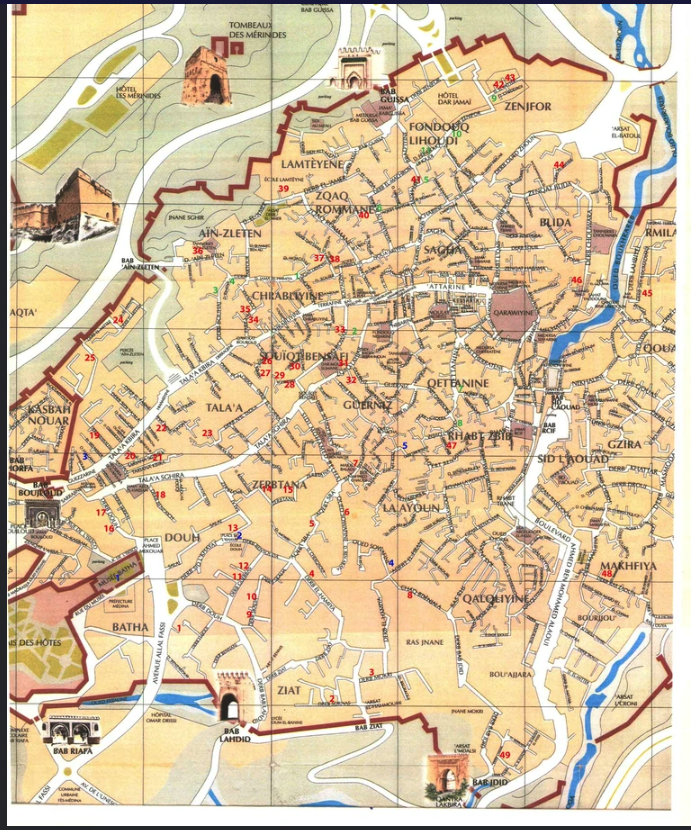


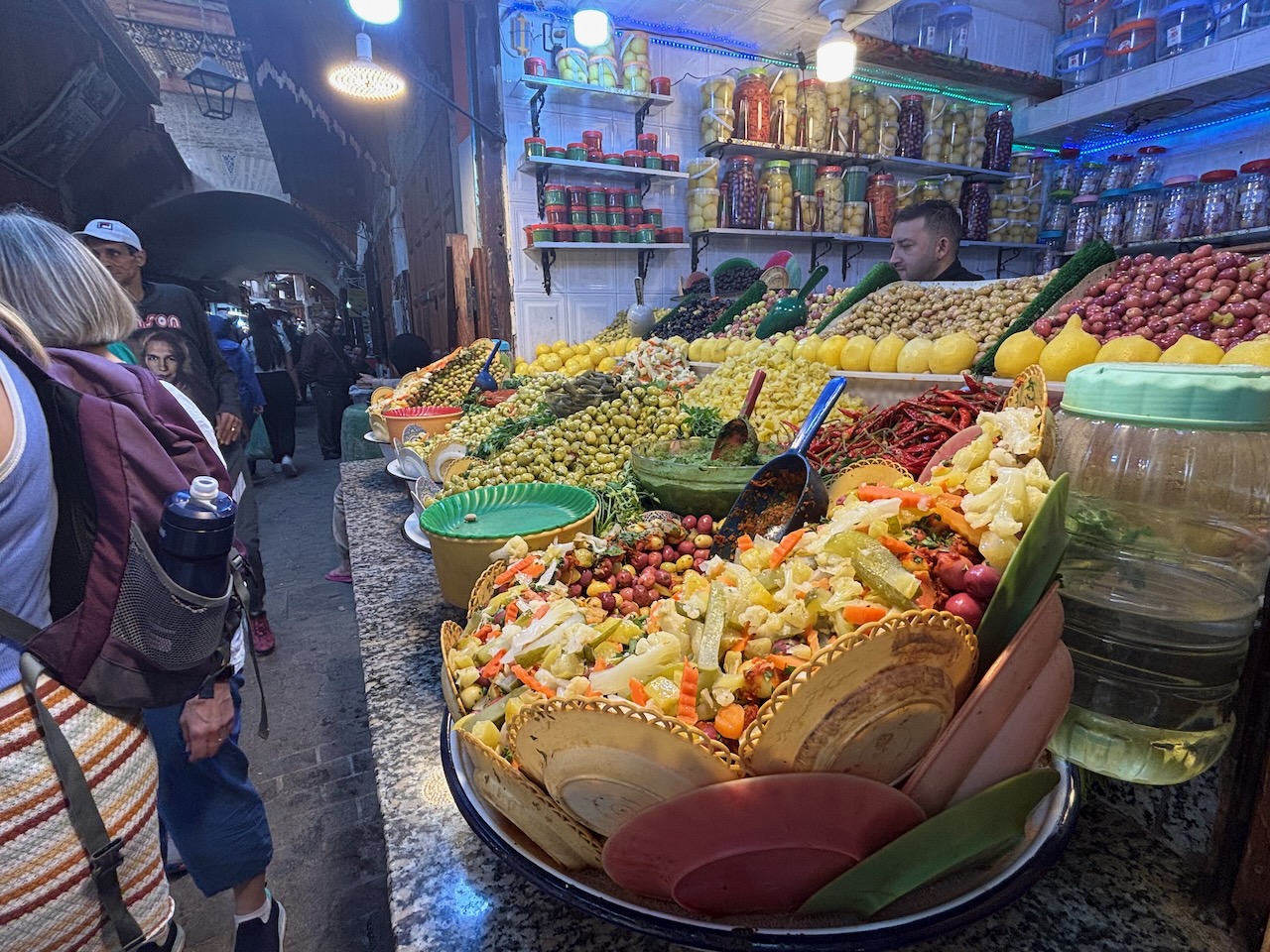
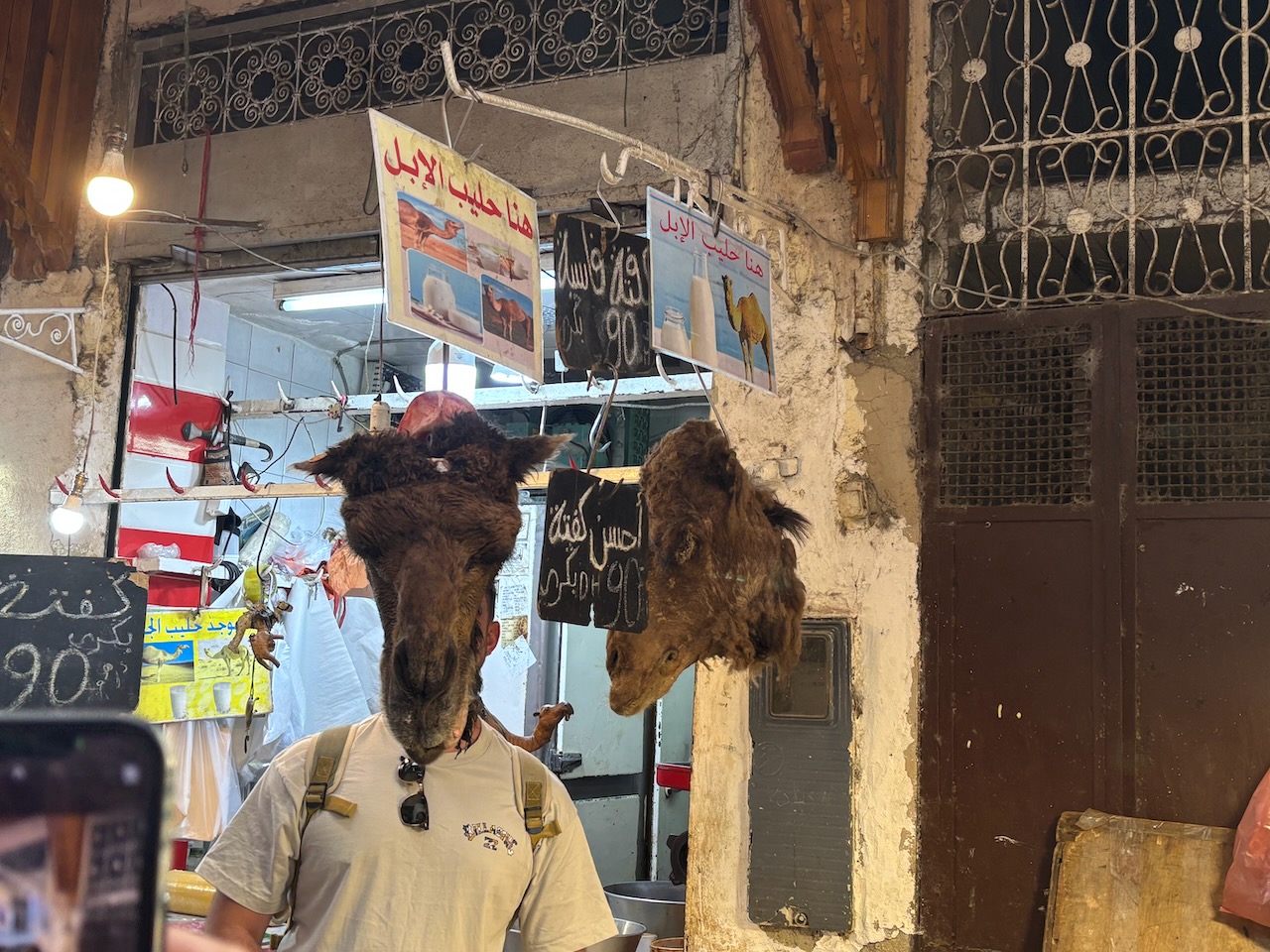

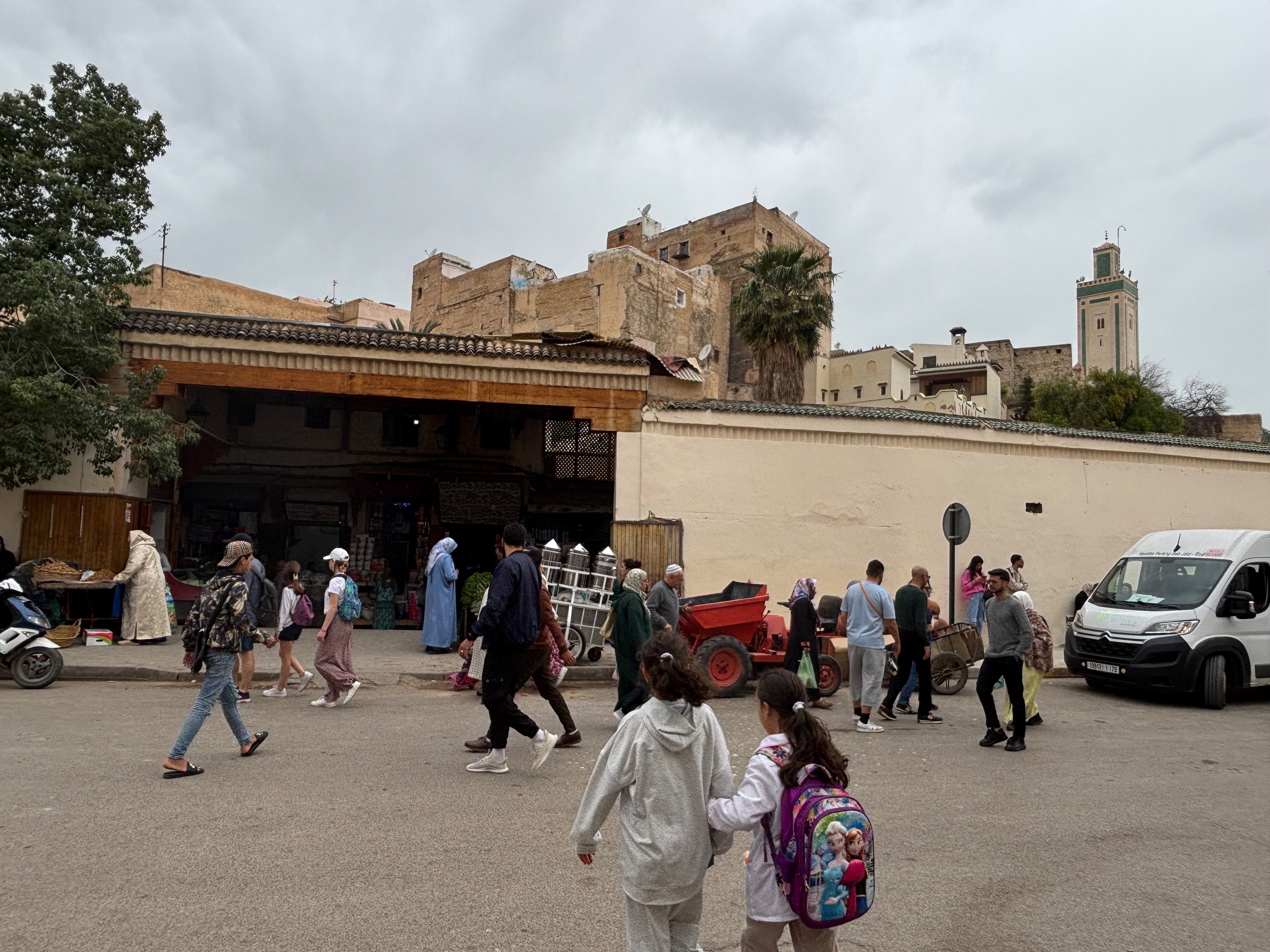
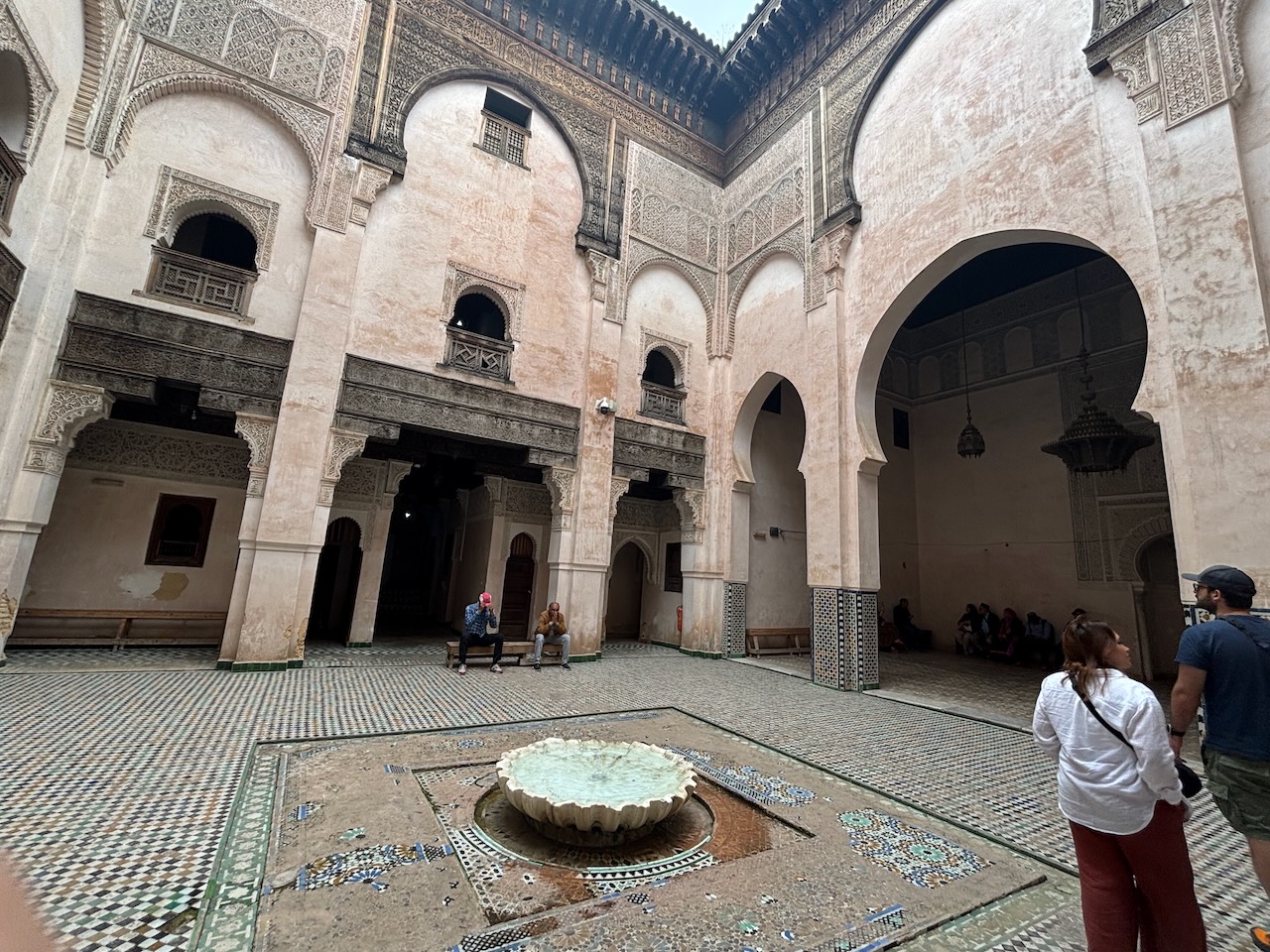
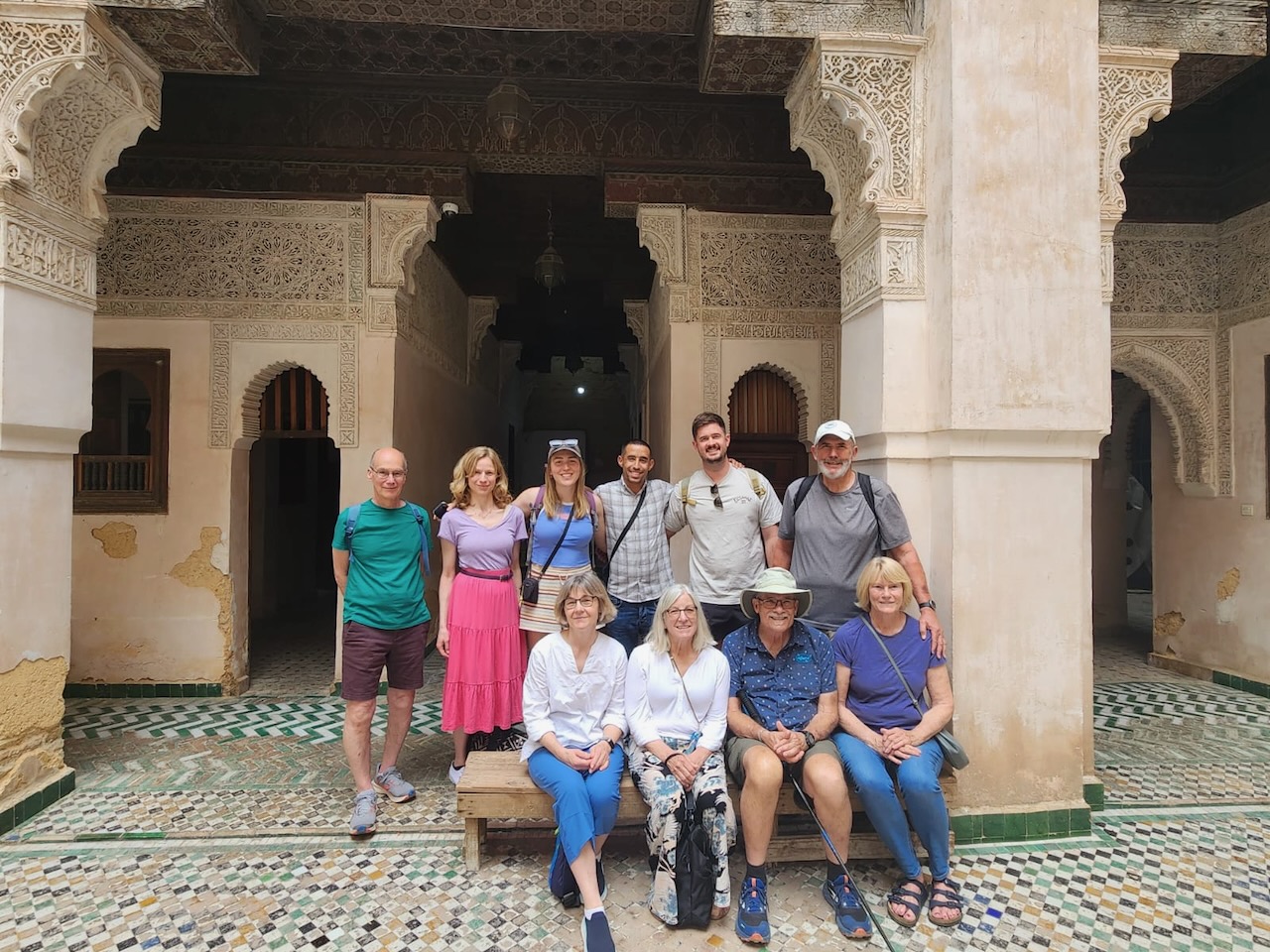
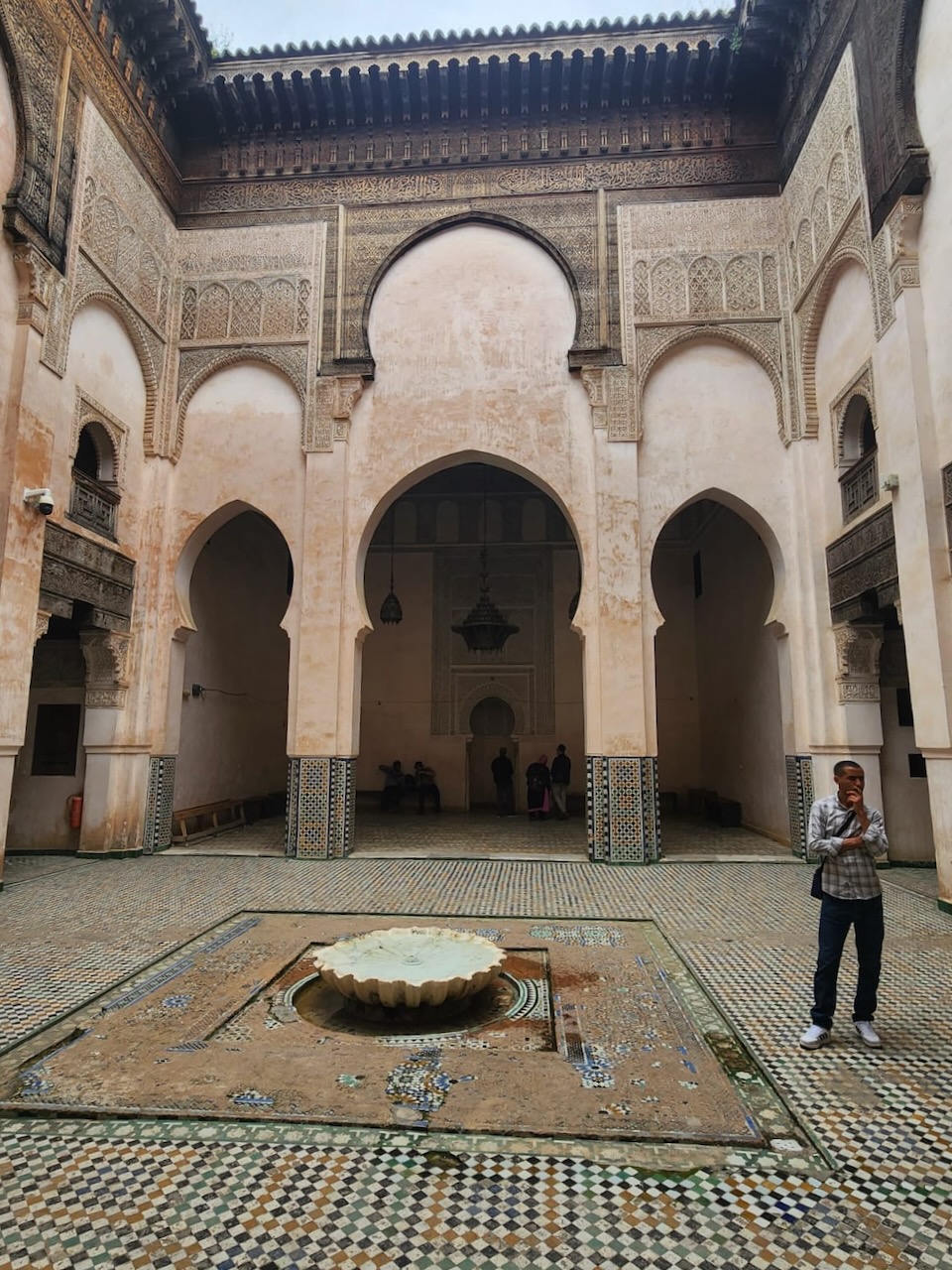
Until you walk through a medina of this size and scope, it is nearly impossible to convey the sights, sounds, smells and overall ambiance of the place. We would end up walking nearly five miles that day, the bulk of it in an endless maze of shops selling whatever product you can imagine, with hundreds of them pretty much selling the same thing. How any of them make money is beyond me. After wandering through aisle after aisle, we stopped in at the Al-Atttarine Madrassa (also known as the Ben Youssef Madrasa) built by the Marinid sultan Uthman II Abu Said in 1323-5. The madrasa takes its name from the Souk al-Attarine, the spice and perfume market. Functioning today as a historical site, the Madrasa was the largest Islamic college in the Maghreb at its height and is widely recognized as a pinnacle of Saadian and Moroccan architecture.
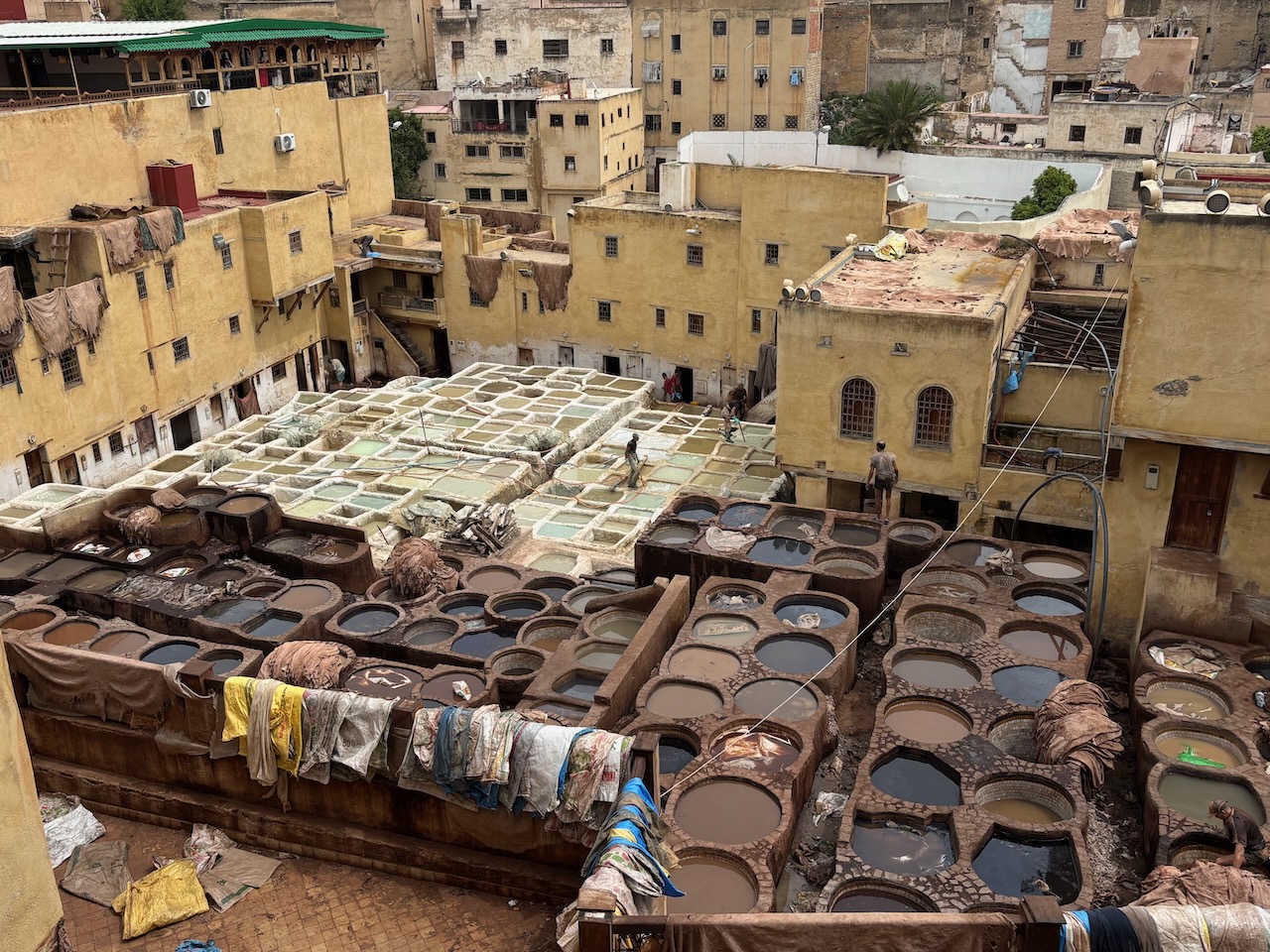
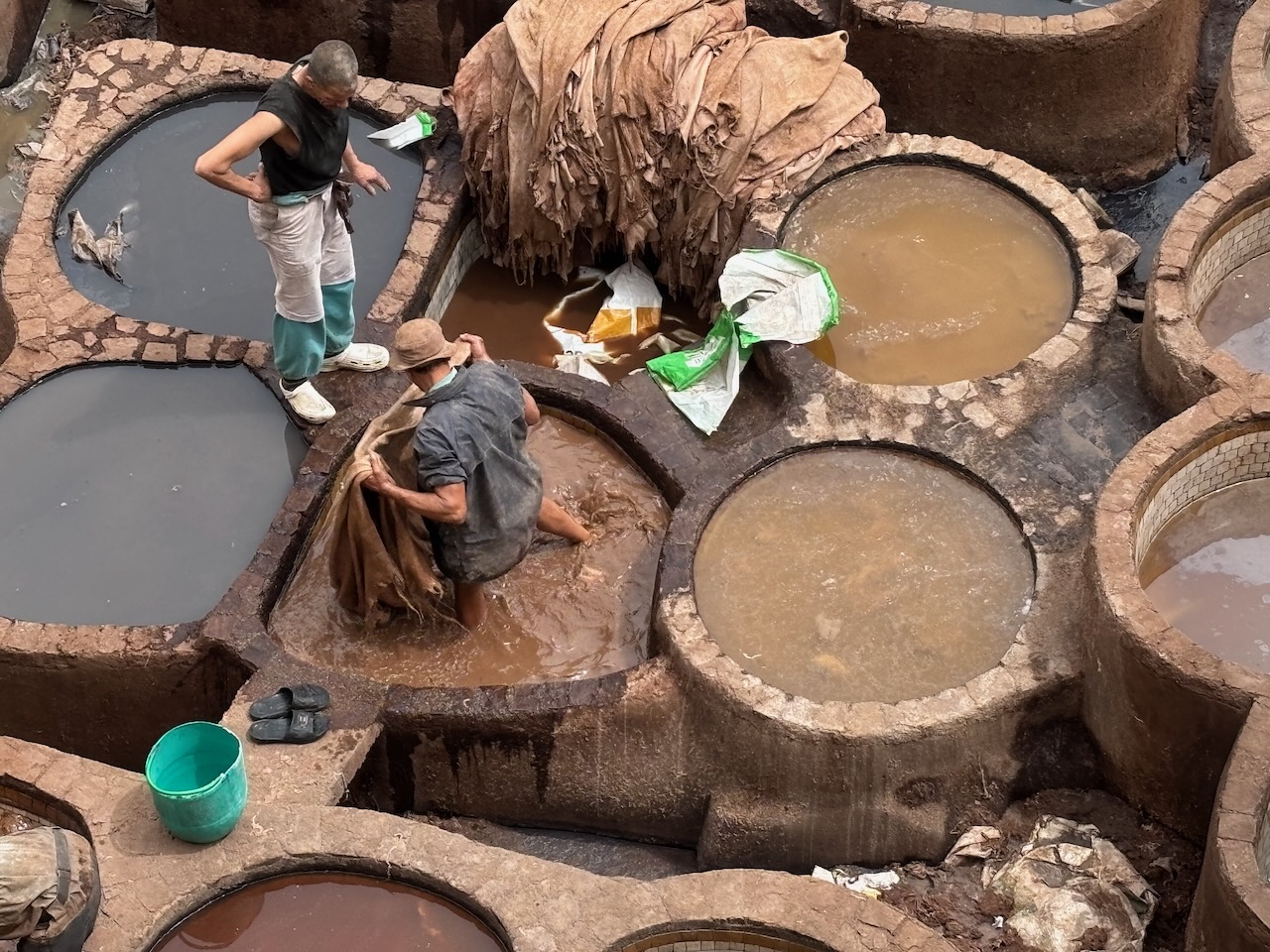
Next up the Chouara Tannery from the 11th century, one of the oldest in the world. Since the inception of the city, the tanning industry has been continually operating in the same fashion as it did in the early centuries. Today, the tanning industry in the city is considered one of the main tourist attractions. The tanneries are packed with round stone vessels filled with dye or white liquids for softening the hides. The leather goods produced in the tanneries are exported around the world. It was fascinating to watch, much like at the tile shop, this is work that manually taxing, highly repetitive and has existed, essentially unchanged, for centuries.
We did spend some time in their retail shop with hundreds of items for sale and Joanna bought a very nice leather belt at a very reasonable price. Our next stop was Le Patio Bleu for our lunch of chicken pastilla. This was to have been our dinner option the night before, but as we were all still full from our satisfying in home lunch in Moulay Idriss, we opted to enjoy it this day. Many of us would choose the Pastilla, while others went for roast lamb with potatoes and carrots.
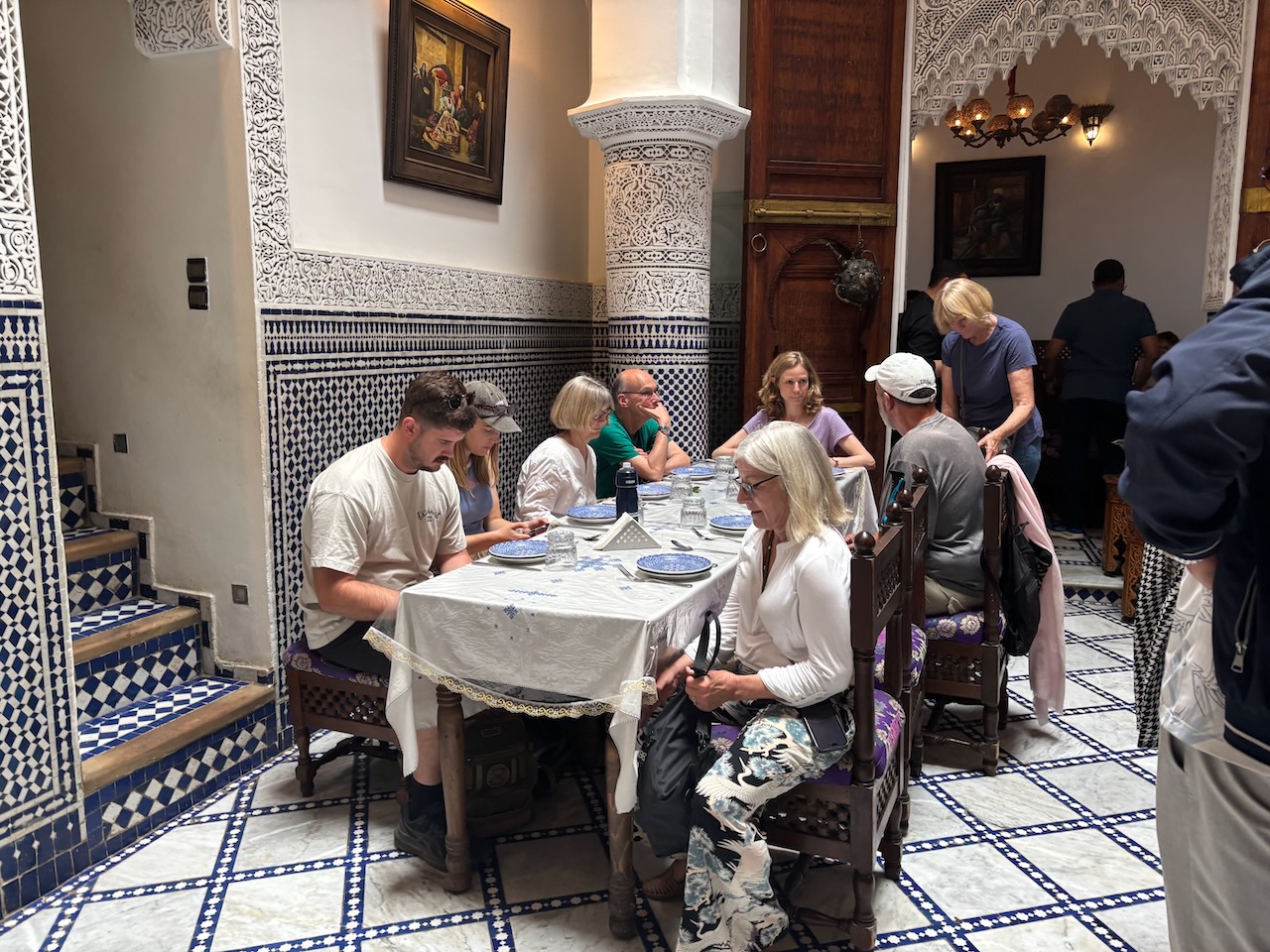
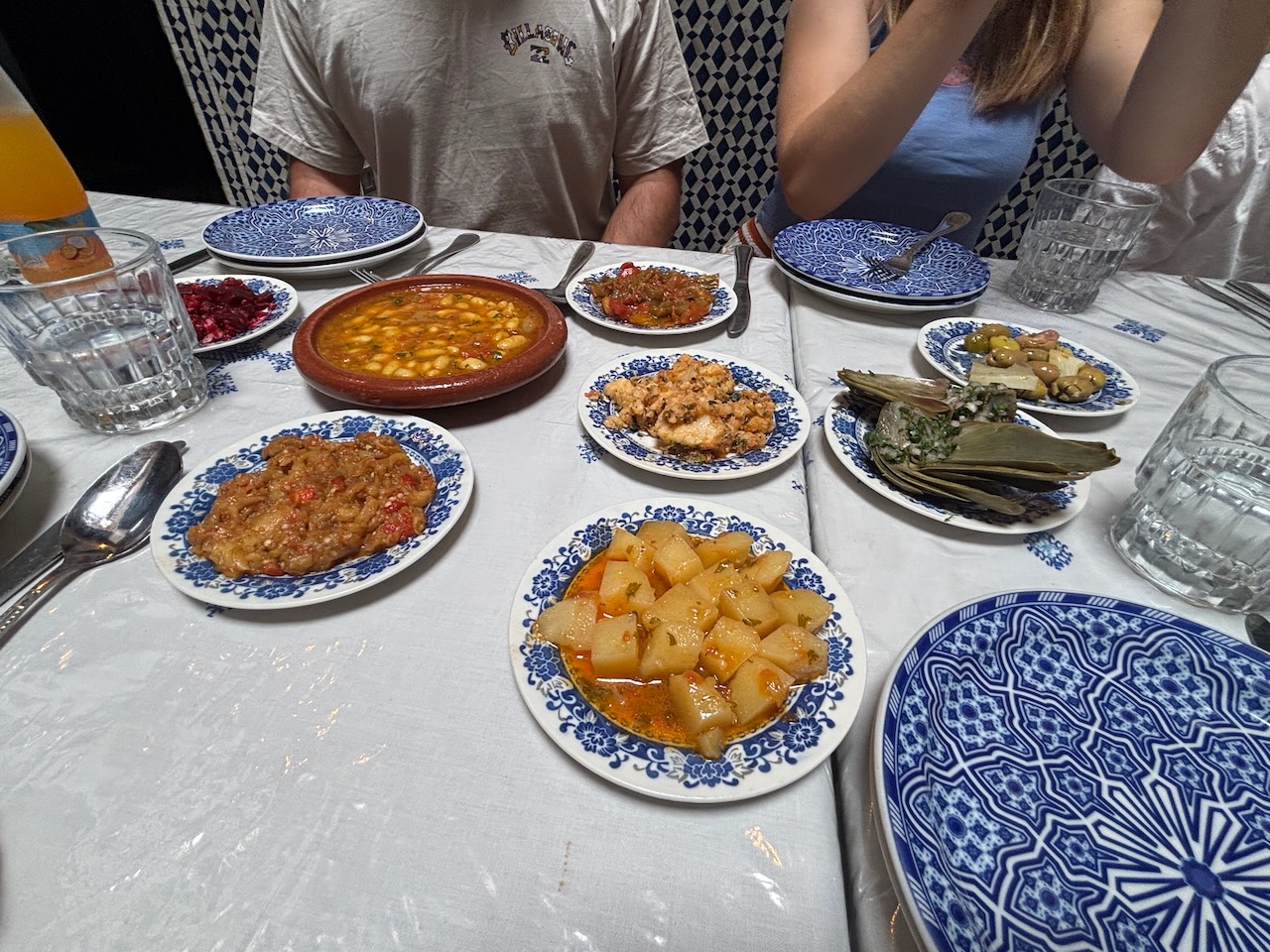
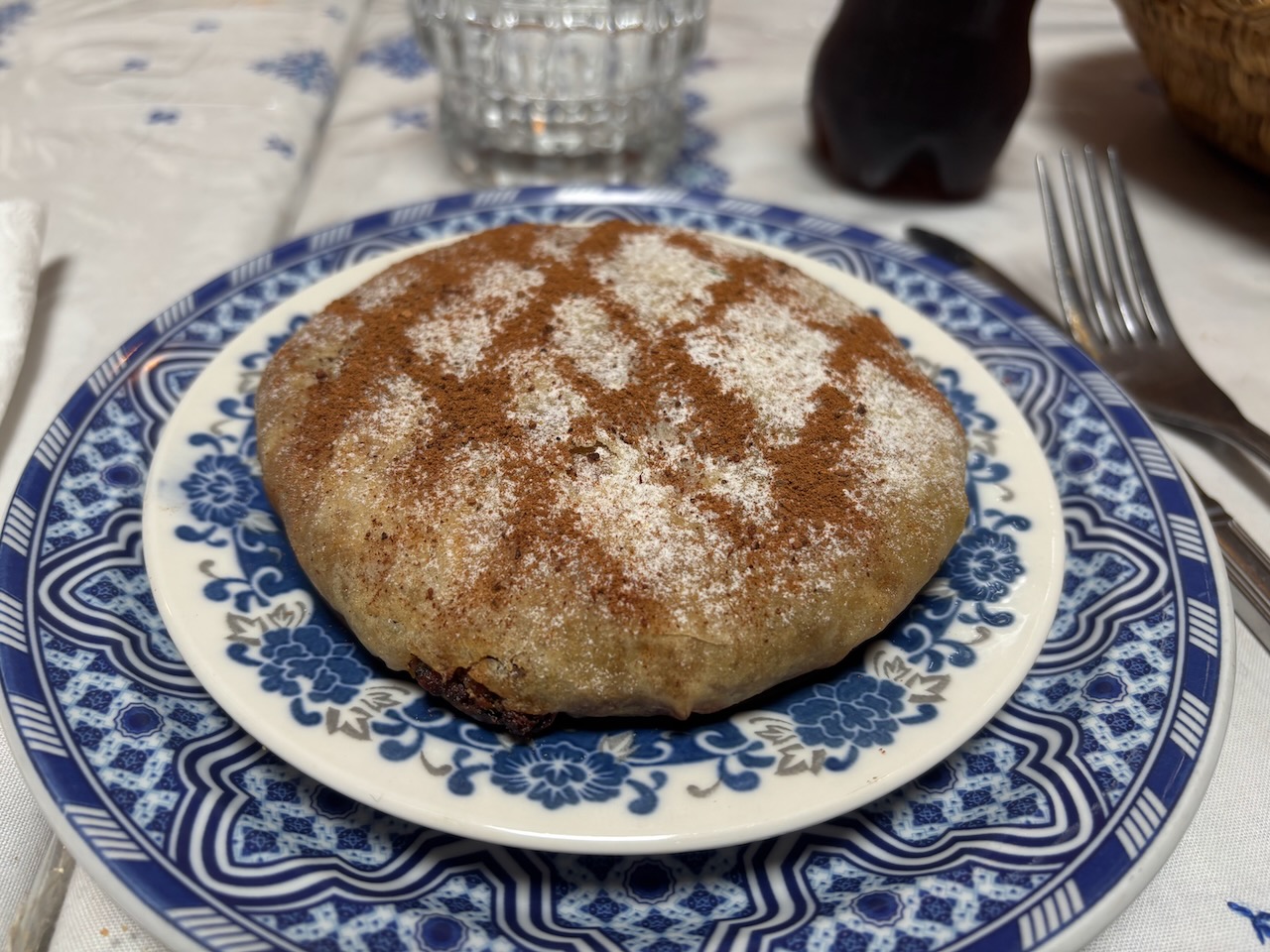
First off, we had a round of small dishes (cooked potatoes, cold vegetables, etc.) and then I had the pastilla, which is known for its unique blend of sweet and savory flavors. The traditional filling often features slow-cooked chicken or pigeon, spiced with ginger, saffron, and cinnamon, then combined with eggs, caramelized onions, and toasted almonds. It is baked in warqa dough (a very fine, crispy pastry, not too dissimilar to filo) to a golden, flaky texture, providing a delightful contrast to the rich and flavorful filling. It was tasty and curiously, it would be the last time we would run across in for the rest of the trip.

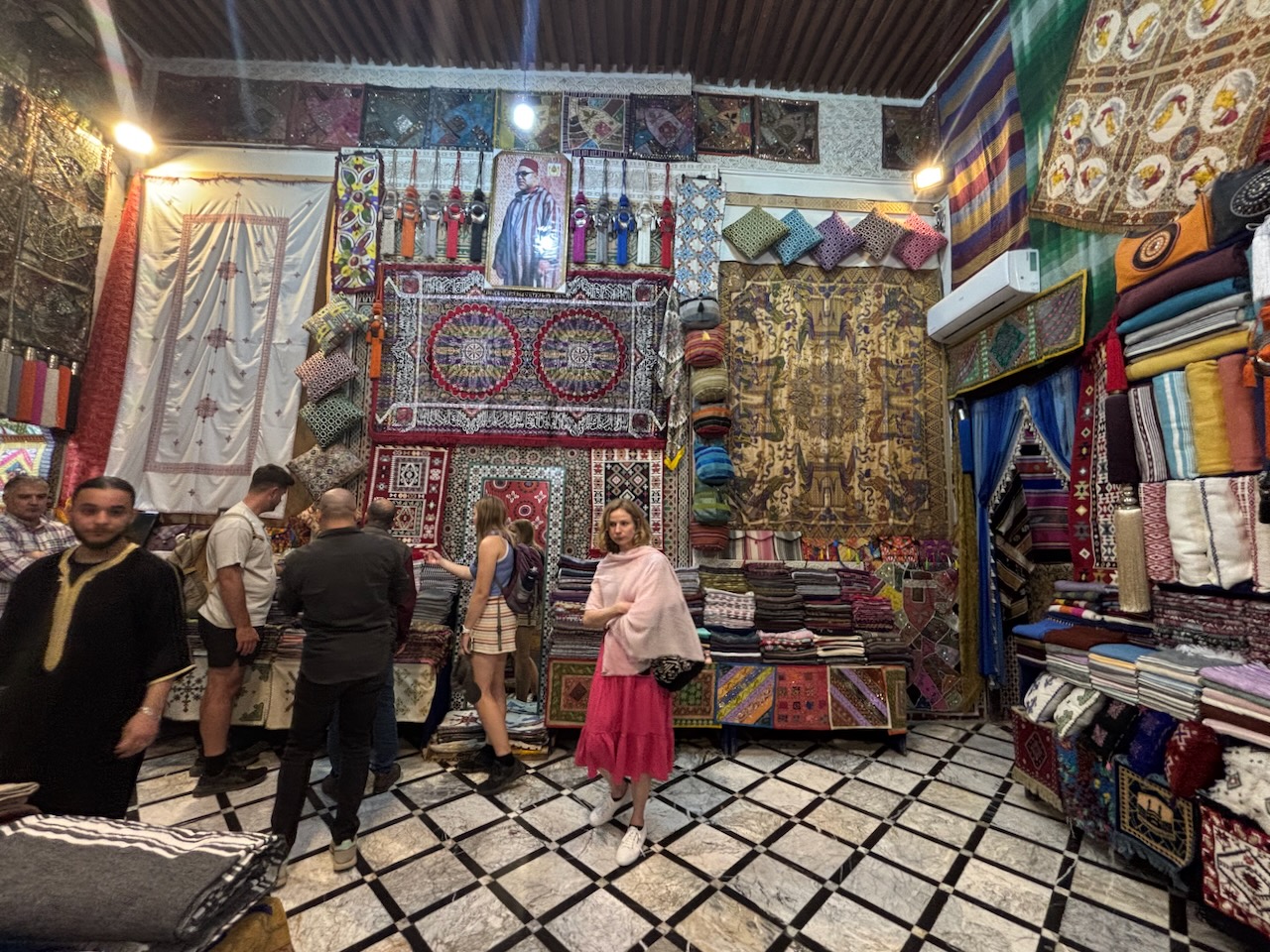
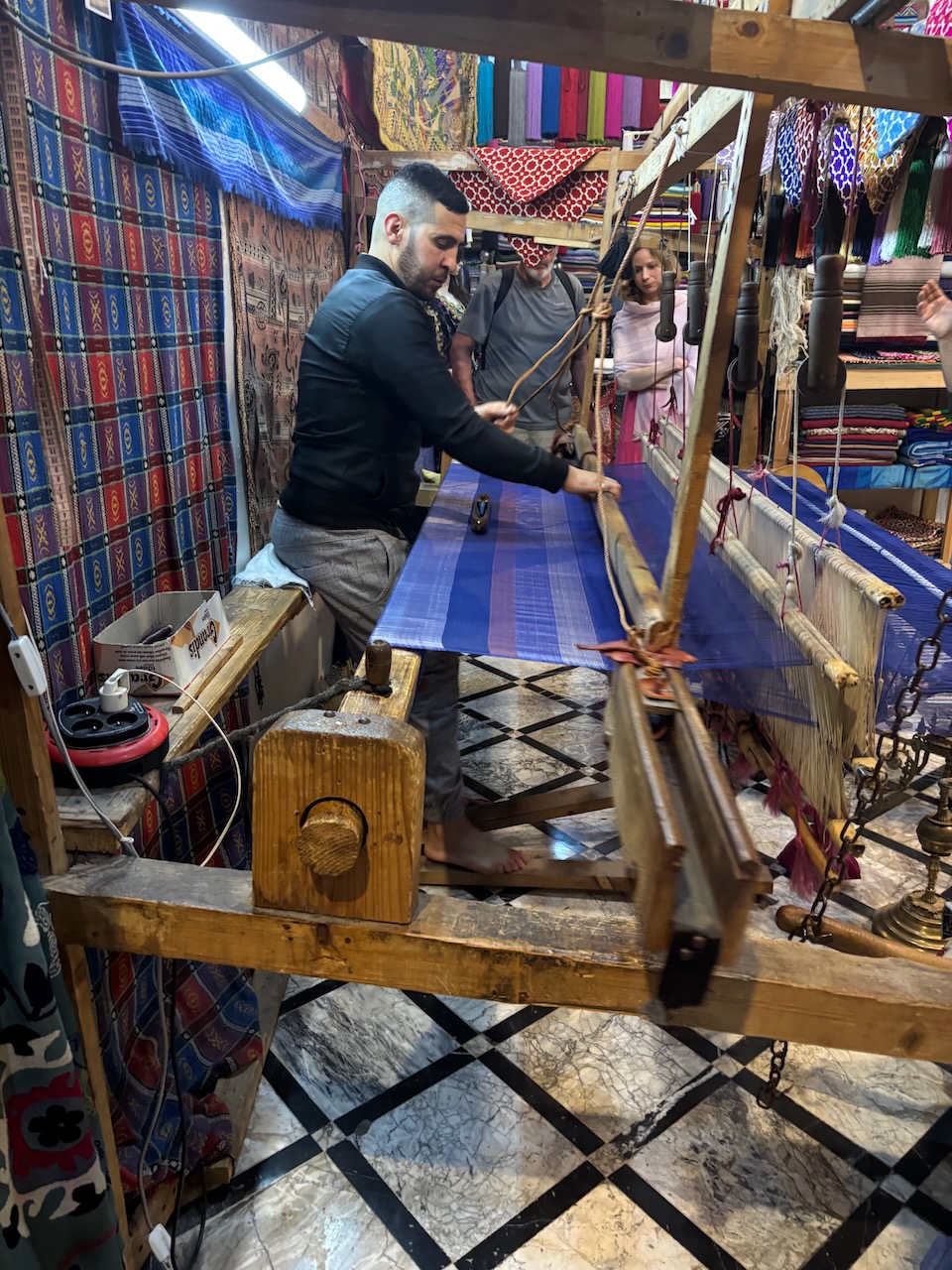
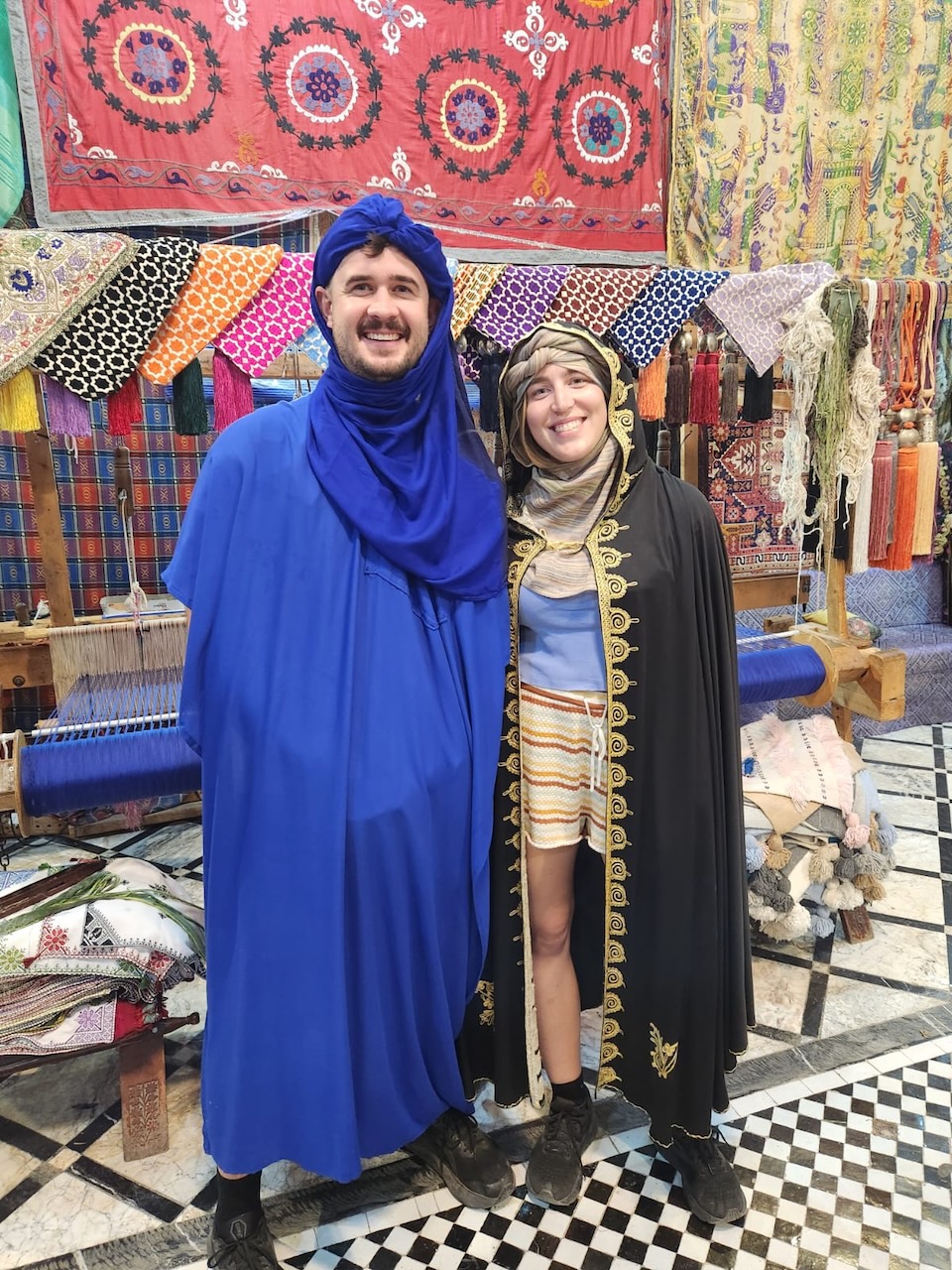
After lunch we visited a shop specializing in woven products and watched as the craftsman worked his loom, propelling its motion with his foot, lacing different colored strands to create the intricate patterns one would find in the products throughout the shop. Although it may sound like one makes a lot of these shopping stops on the tour, they are actually informative and if you are inclined to purchase, are pretty much assured that you price you pay will be a reasonable one for a good quality product.
And that would be it for us and the Medina, returning to our Riad with a last stop at the Carrefour for more provisions, we had a nice relaxing charcuterie dinner in the lobby there. Fes had been eye opening, a peek at the multifaceted nature of Moroccan life. And next up would be the Sahara Desert. And a camel ride, which in no way I looked forward to. We’ll cover how that all went in the next post.
Links
Art Naji: https://artnaji.com/en/home-2/
Chouara Tannery: https://moroccantannery.com/
Le Patio Bleu: https://wanderlog.com/place/details/1092494/le-patio-bleu
Blog Post 7-27-2025
Europe 2025 – Intrepid Morocco – Fes, Part Three
April 9 – 10
We’d met our guide for the medina at the Bab Bou Jeloud City Gate and he led us through the street that comprised the Jewish quarter where we climbed back into the van for a ride out to the Art Naji Pottery and Tile shop, first stopping at an overlook that provided a nice view of the city and its walls. Back in the van we drove back down the hill into town to the shop, our opportunity to witness local craftsmen making all kinds of pottery and tiles that would have many uses, including wrought iron furniture.
These folks produce beautiful products but one of the main things I came away with, and this would be reinforced throughout the day, was how monotonously dull and repetitive much of the work is and for some, how uncomfortable the working conditions might be. Our first stop was the concrete tubs where the raw clay is cured and then pulled out for use in the making of the pottery and tiles.
Our next stop was the pottery room, where we observed men and women in the process of either forming pots, urns, plates and tagine or engaged in decorating them. In particular one fellow was creating an intricate geometric pattern without the aid of a stencil, that is completely freehanded.
We stepped outside to watch three men performing what seemed to be the most monotonous and repetitive work imaginable, that is chipping away at colored pieces of tile to shape them to the size needed to be placed into the tables tops and fountains we’d watch being assembled later in our tour of the facility. Next, we observed a lone craftsman putting tiles into place in order to create a round tabletop. The amazing thing about this process is that he does it upside down, that is he can’t see the pattern he is creating as he works, but must do so from memory. It is like watching a magic act unfold.
Our last stop here, as it is with all stops of this nature was the large gift shop, stacked with multiple levels of product, all quite enticing but not really needing anything of the nature of what was offered, we all passed on buying. On our way out we passed by a women entering order information into a computer and then stacks of packaged product ready to be shipped out.
Back in the van, we drove a short distance and parked within walking distance of a square that led to the maze of streets that would be our home for the next few hours. The historic city of Fez consists of Fes el-Bali, the original city on both shores of the Oued Fes (River of Fez), and the smaller Fez Jdid, founded on higher ground to the west in the 13th century. It is distinct from Fez’s now much larger Ville Nouvelle (new city). Fes el-Bali is the oldest continuously inhabited walled city in the Arab world, and one of the largest and oldest urban pedestrian zones (car-free areas) in the whole world. These two historic cities are linked together and are usually referred to together as the “medina” of Fez, though this term is sometimes applied more restrictively to Fes el-Bali only. It is also the site of the famous Qarawiyyin University, founded as a mosque by Fatima al-Fihri in 857–859 and subsequently became one of the leading spiritual and educational centers of the Islamic Golden Age.
Until you walk through a medina of this size and scope, it is nearly impossible to convey the sights, sounds, smells and overall ambiance of the place. We would end up walking nearly five miles that day, the bulk of it in an endless maze of shops selling whatever product you can imagine, with hundreds of them pretty much selling the same thing. How any of them make money is beyond me. After wandering through aisle after aisle, we stopped in at the Al-Atttarine Madrassa (also known as the Ben Youssef Madrasa) built by the Marinid sultan Uthman II Abu Said in 1323-5. The madrasa takes its name from the Souk al-Attarine, the spice and perfume market. Functioning today as a historical site, the Madrasa was the largest Islamic college in the Maghreb at its height and is widely recognized as a pinnacle of Saadian and Moroccan architecture.
Next up the Chouara Tannery from the 11th century, one of the oldest in the world. Since the inception of the city, the tanning industry has been continually operating in the same fashion as it did in the early centuries. Today, the tanning industry in the city is considered one of the main tourist attractions. The tanneries are packed with round stone vessels filled with dye or white liquids for softening the hides. The leather goods produced in the tanneries are exported around the world. It was fascinating to watch, much like at the tile shop, this is work that manually taxing, highly repetitive and has existed, essentially unchanged, for centuries.
We did spend some time in their retail shop with hundreds of items for sale and Joanna bought a very nice leather belt at a very reasonable price. Our next stop was Le Patio Bleu for our lunch of chicken pastilla. This was to have been our dinner option the night before, but as we were all still full from our satisfying in home lunch in Moulay Idriss, we opted to enjoy it this day. Many of us would choose the Pastilla, while others went for roast lamb with potatoes and carrots.
First off, we had a round of small dishes (cooked potatoes, cold vegetables, etc.) and then I had the pastilla, which is known for its unique blend of sweet and savory flavors. The traditional filling often features slow-cooked chicken or pigeon, spiced with ginger, saffron, and cinnamon, then combined with eggs, caramelized onions, and toasted almonds. It is baked in warqa dough (a very fine, crispy pastry, not too dissimilar to filo) to a golden, flaky texture, providing a delightful contrast to the rich and flavorful filling. It was tasty and curiously, it would be the last time we would run across in for the rest of the trip.
After lunch we visited a shop specializing in woven products and watched as the craftsman worked his loom, propelling its motion with his foot, lacing different colored strands to create the intricate patterns one would find in the products throughout the shop. Although it may sound like one makes a lot of these shopping stops on the tour, they are actually informative and if you are inclined to purchase, are pretty much assured that you price you pay will be a reasonable one for a good quality product.
And that would be it for us and the Medina, returning to our Riad with a last stop at the Carrefour for more provisions, we had a nice relaxing charcuterie dinner in the lobby there. Fes had been eye opening, a peek at the multifaceted nature of Moroccan life. And next up would be the Sahara Desert. And a camel ride, which in no way I looked forward to. We’ll cover how that all went in the next post.
Links
Art Naji: https://artnaji.com/en/home-2/
Chouara Tannery: https://moroccantannery.com/
Le Patio Bleu: https://wanderlog.com/place/details/1092494/le-patio-bleu
Discover more from 3jmann
Subscribe to get the latest posts sent to your email.


 3jmann