May 8 – 9
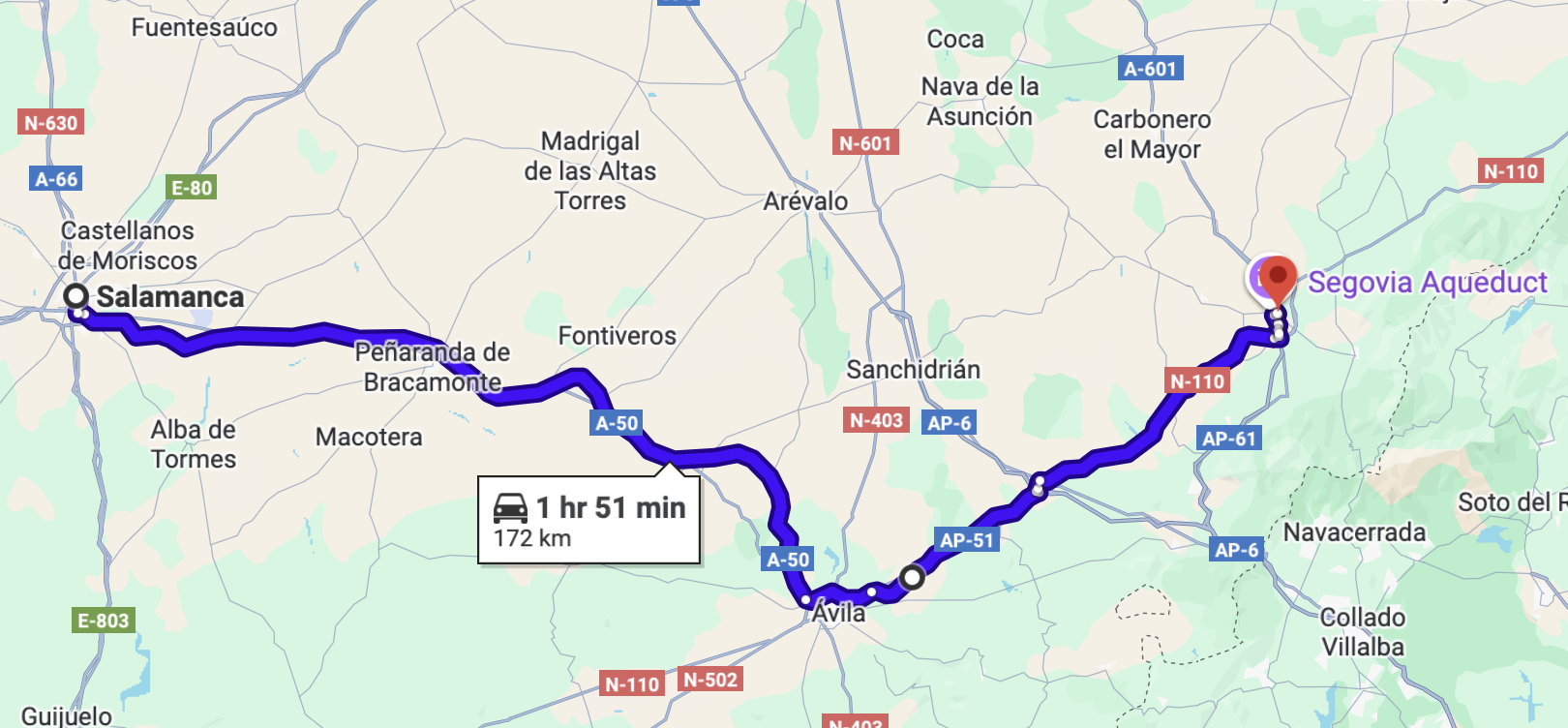
Our drive to Segovia would be another short one, but with nothing much to see on the way we stayed at the condo until check out time which would get us to our hotel right around check in time. The drive went well until we reached town and then we hit one of those driving nightmares that make for a funny story afterwards. It was all on me as I’d failed to dive deep enough at the hotel’s web site to note that they gave a different address for those driving in as opposed to those using public transportation as the hotel was smack dab in the middle of the old town.
The GPS did as it is supposed to, guiding us to the hotel’s walk in address which led us to continually narrowing streets, one where we had to move tables outside a restaurant in order to pass through, eventually landing us at a broad plaza where it became obvious that the car shouldn’t be where it was. We sent Joanna ahead on foot to the hotel, a couple of blocks away to determine our best course of action and in the meantime two local police officers approached the car and we began to dialogue.
One, the guy, spoke passable English and the other, a woman, didn’t and she because of this, she appeared to want to arrest us on the spot. Between my rudimentary Spanish and his English, we determined, obviously, that I wasn’t supposed to be there and he eventually directed me to a street one block away that I could turn onto and escape our dilemma. Around this time Joanna rejoined us with the correct address which would turn out to be right on the street we’d used to exit the plaza.
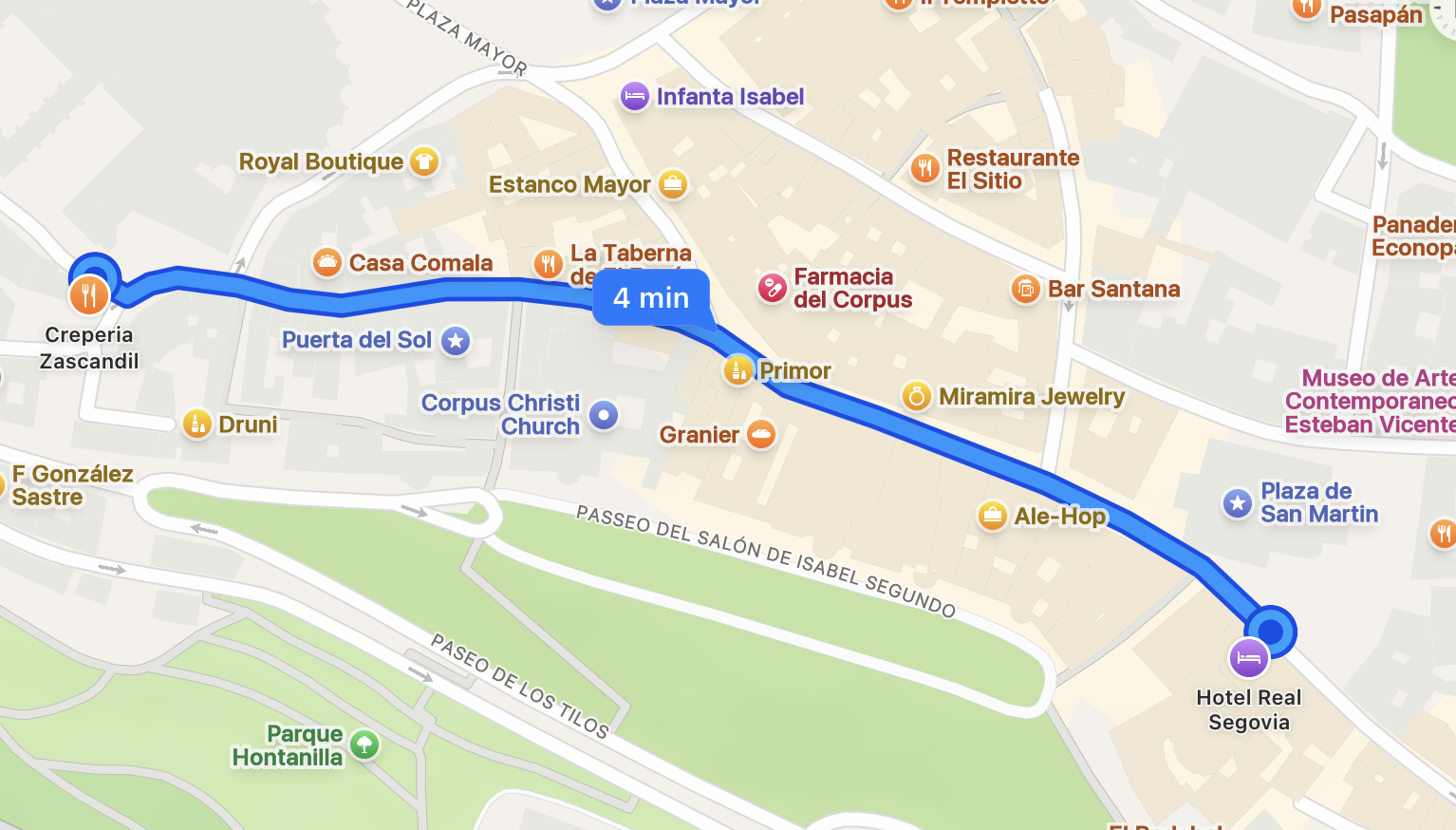
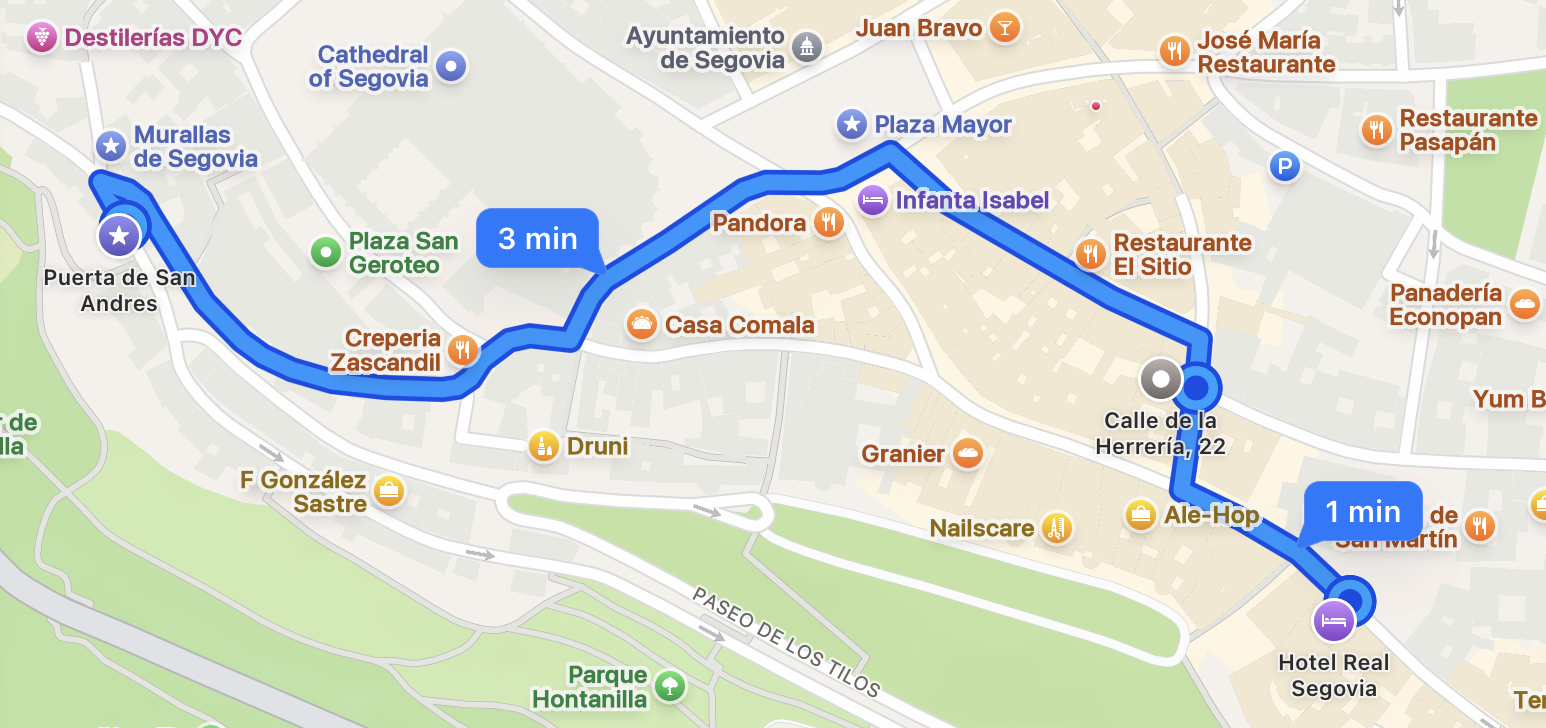
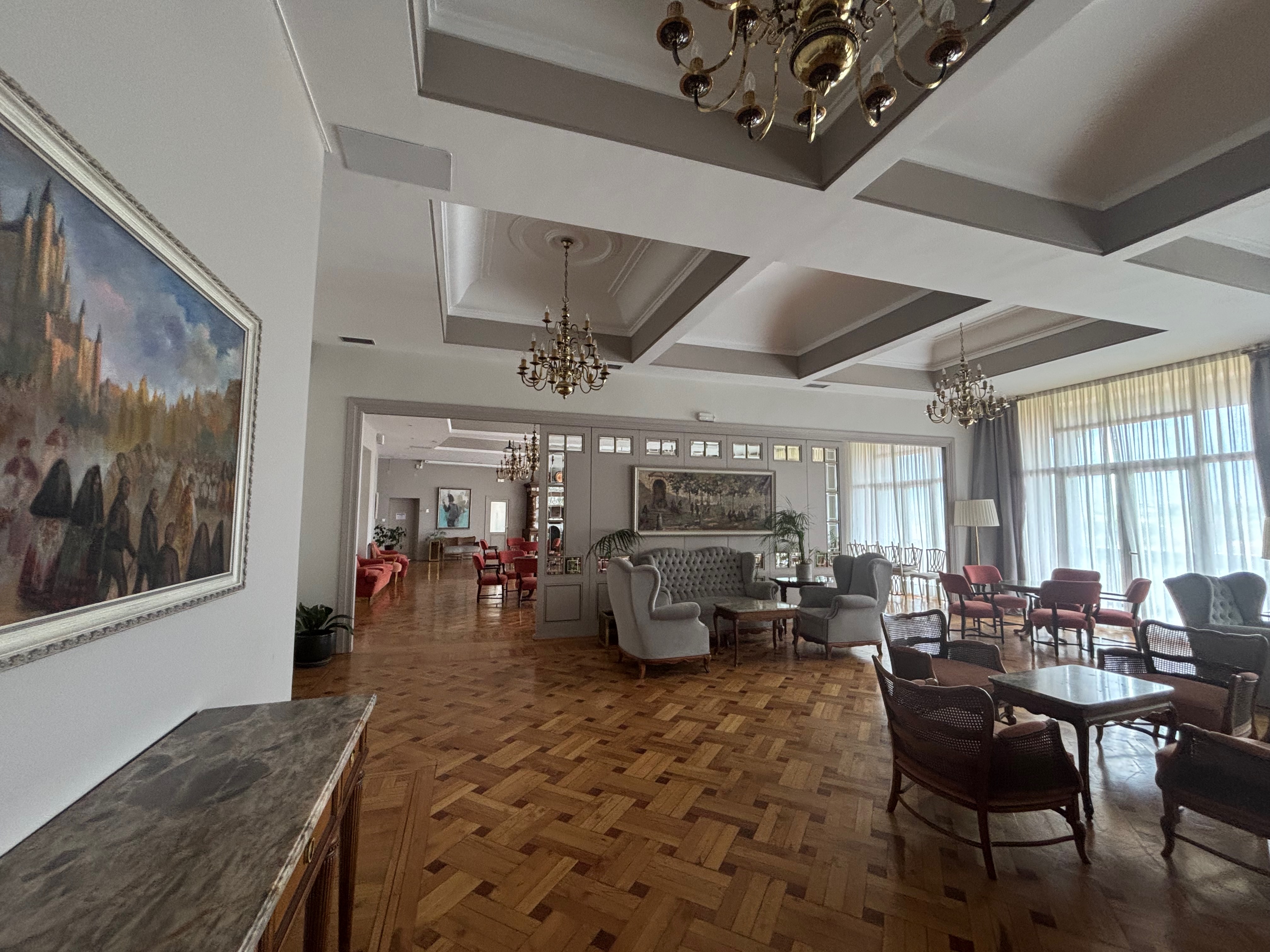
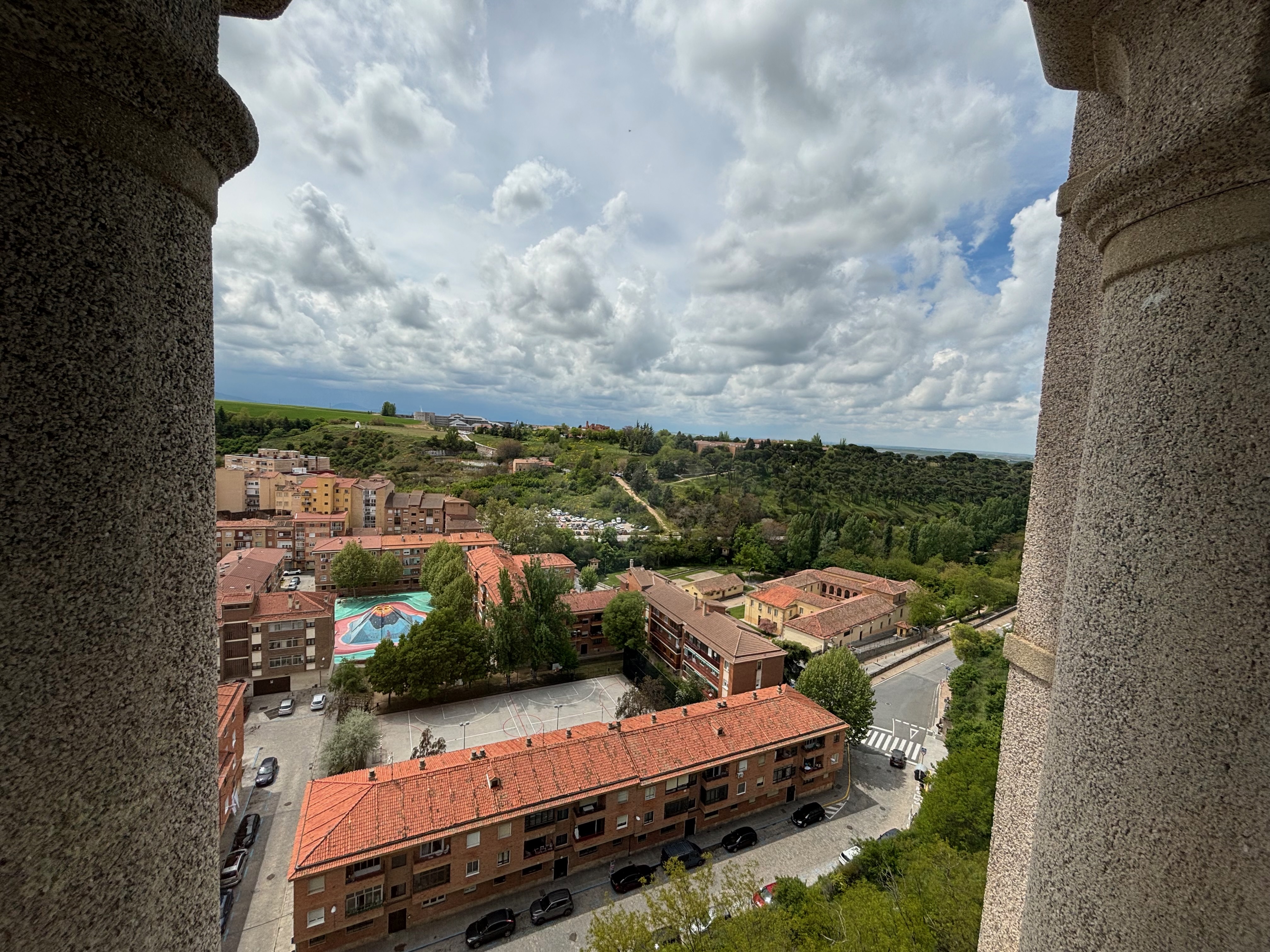
Not knowing this, we ended up completely circling the town again and finally reaching the correct address where we parked and walked the block or so to Hotel Real Segovia, a St. Steves recommendation which we’d chosen as there were no reasonable or nicely located Airbnb’s available. Once we landed there, appreciated its location and ambience, as the guidebook describes it as a “classic hotel (quick to brag about the many old-time movie stars who stayed here). They rent 37 beautifully updated rooms with all the modern amenities right along the main drag, between the aqueduct and Plaza Mayor. In spite of its central location, many of its rooms face the quiet countryside.”
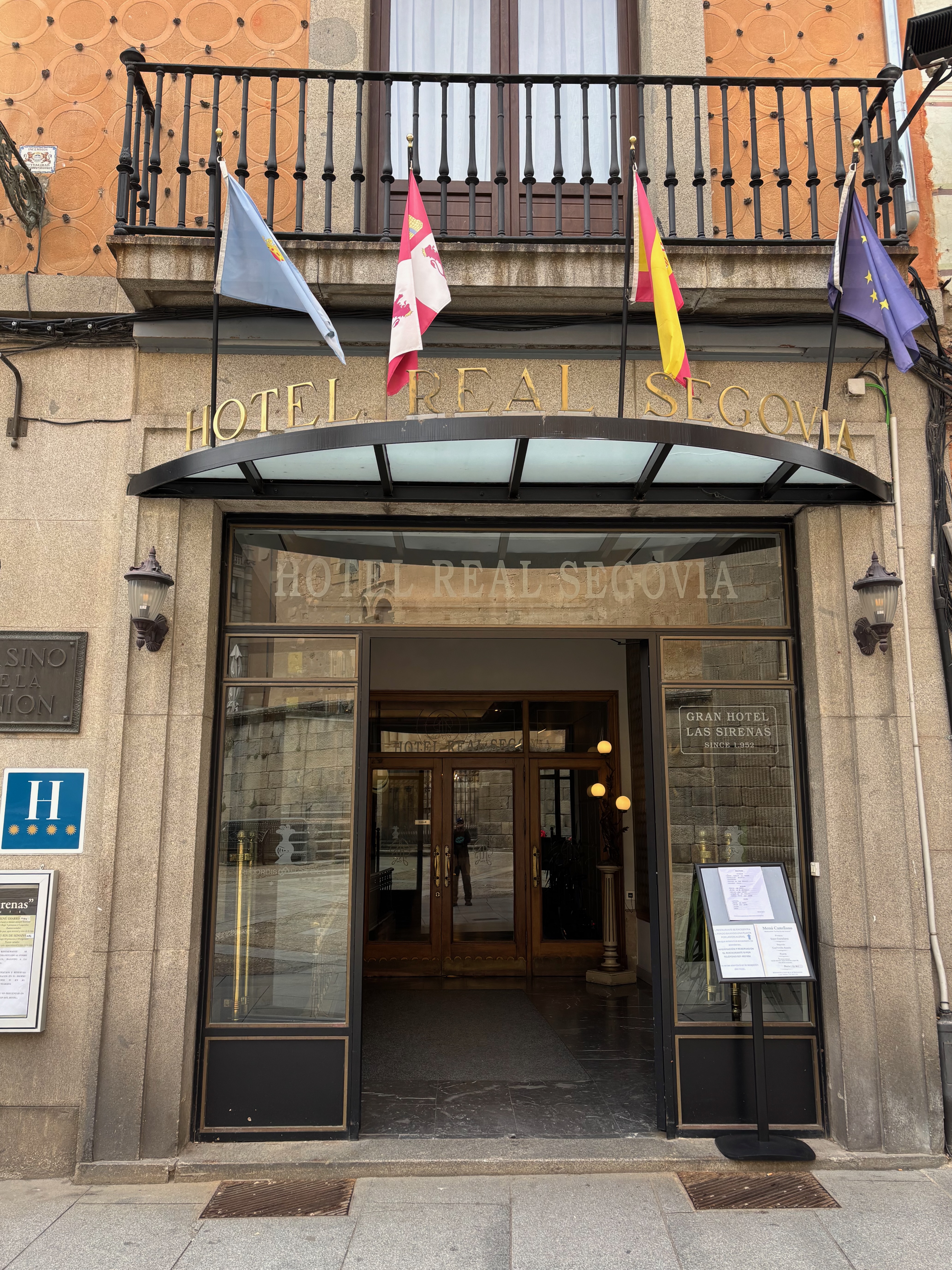
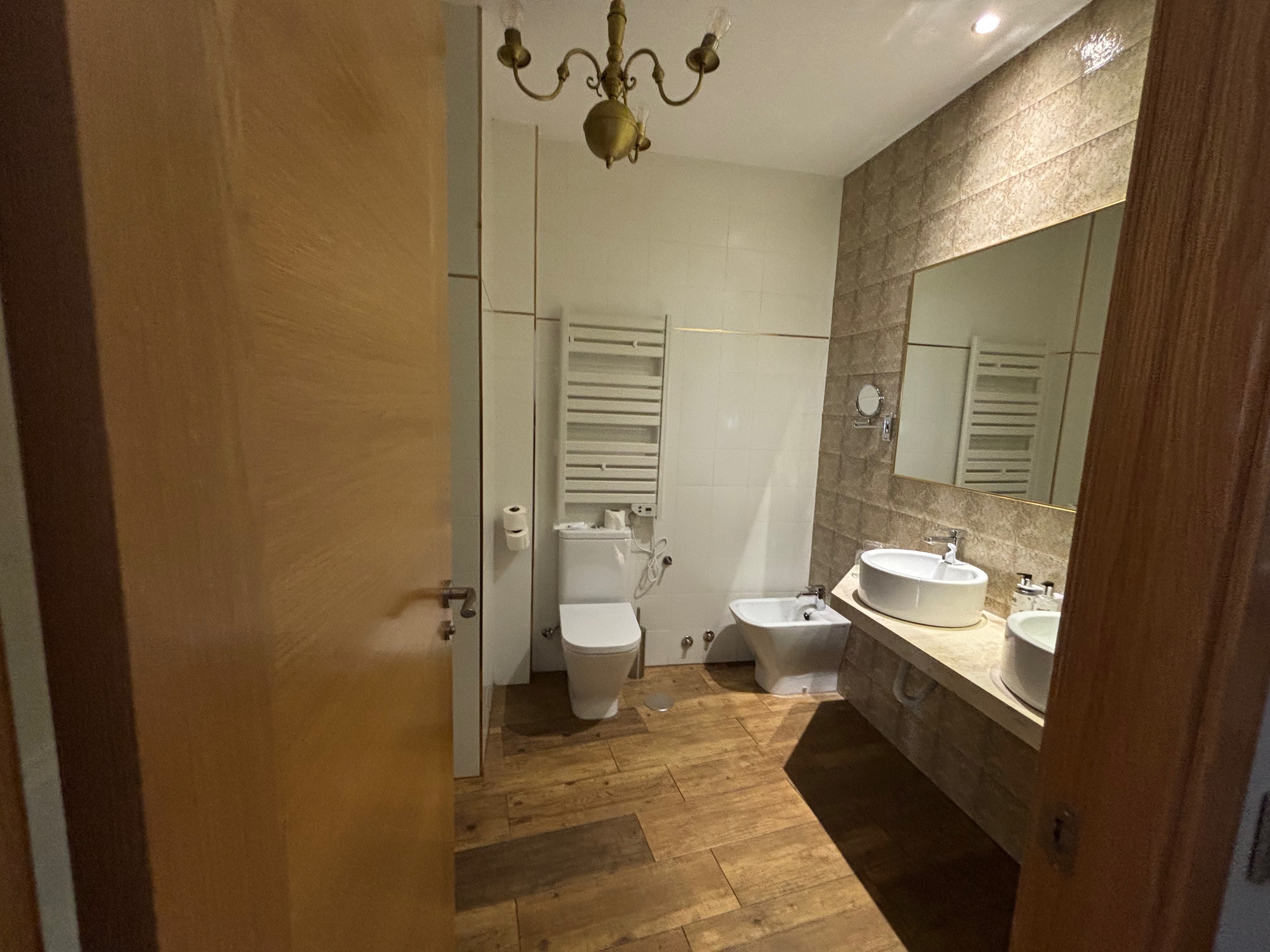
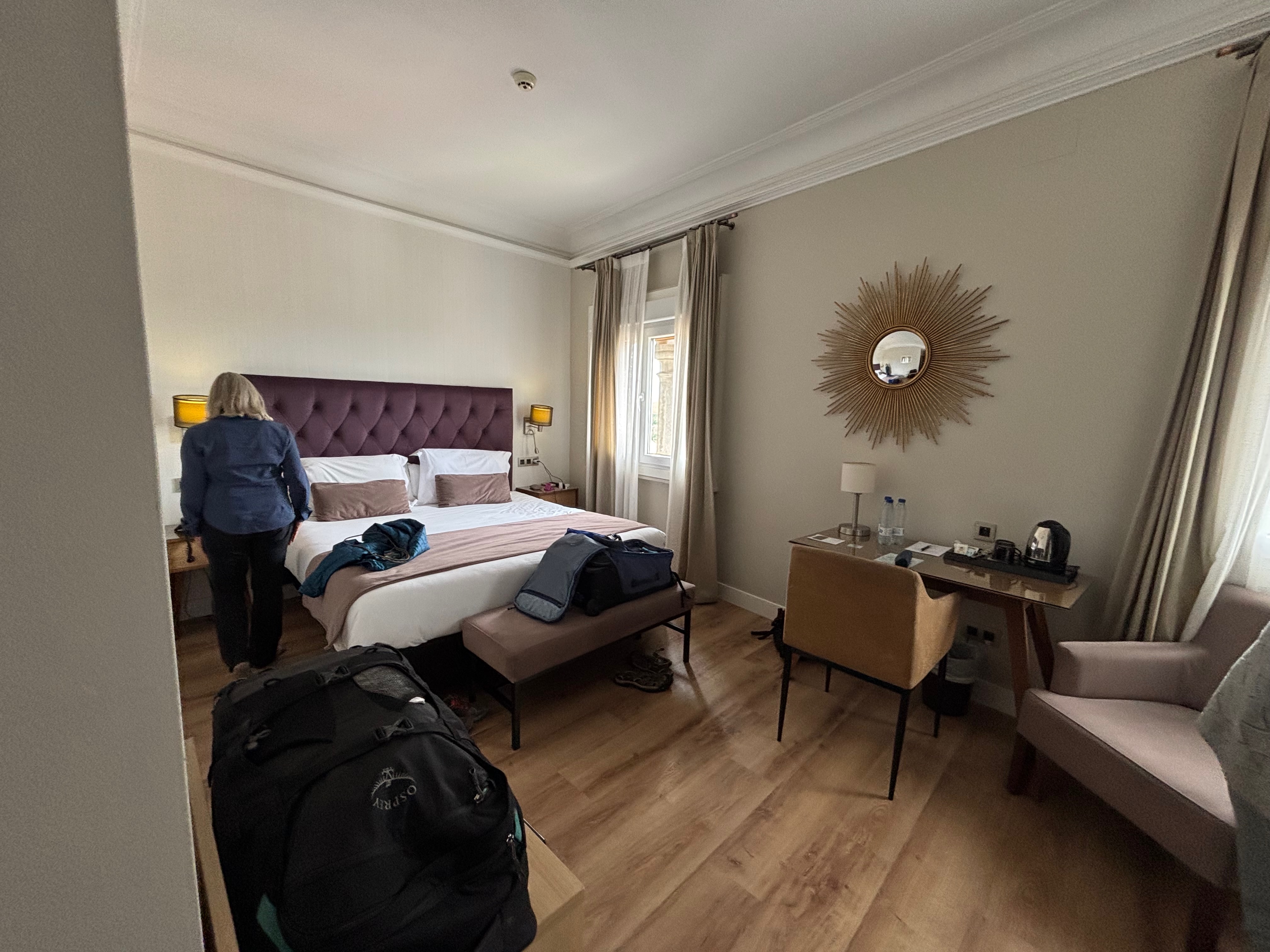
Check in went smoothly and they sent someone to fetch and park the car, a welcome relief and after settling into our shared room with Bev, which ran us 367 Euros ($376) for the two nights , including parking, we hit the streets to check out the neighborhood, where we located a small market for supplies and then returned to our room to relax with drinks before heading out for dinner.
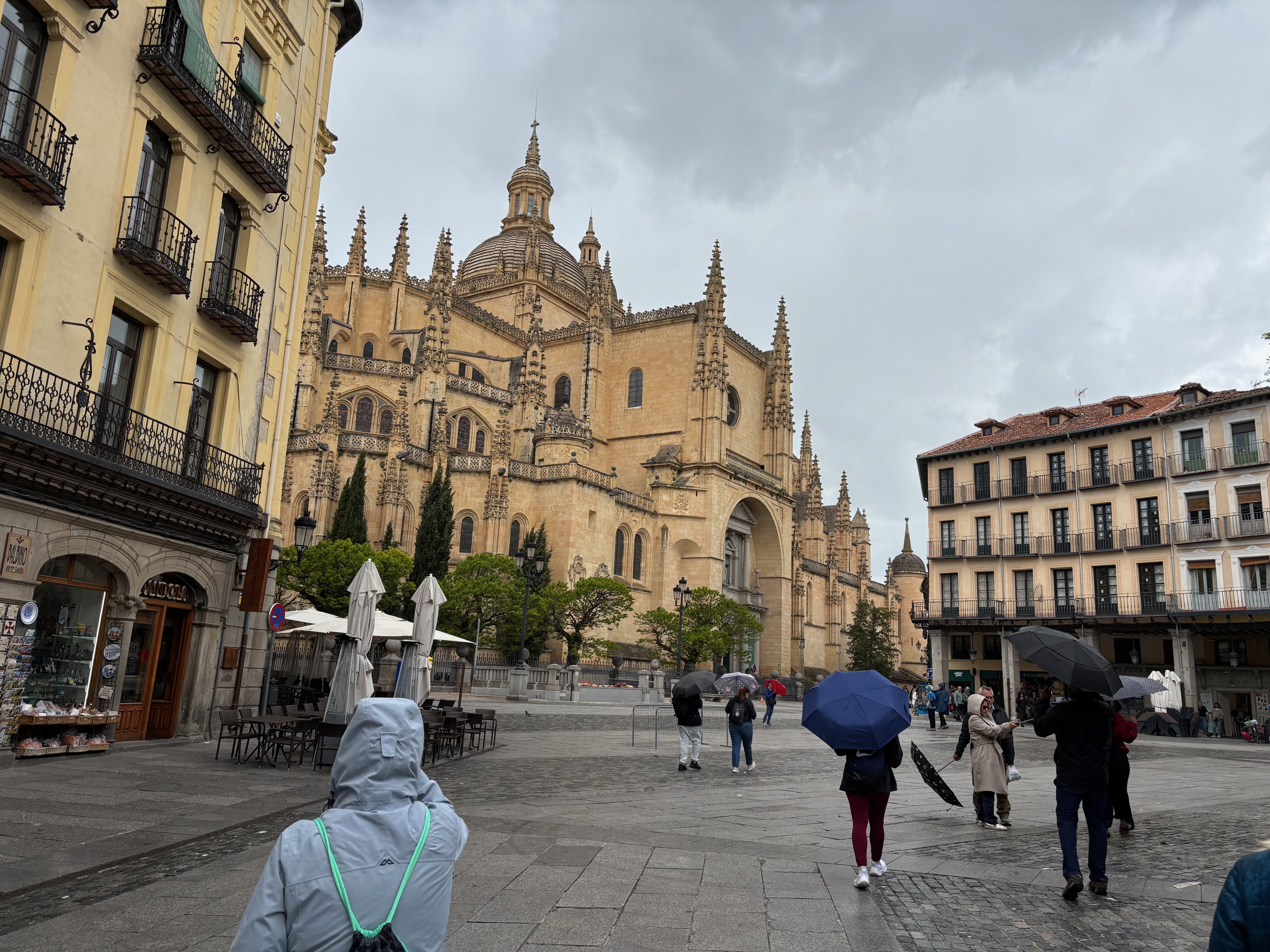
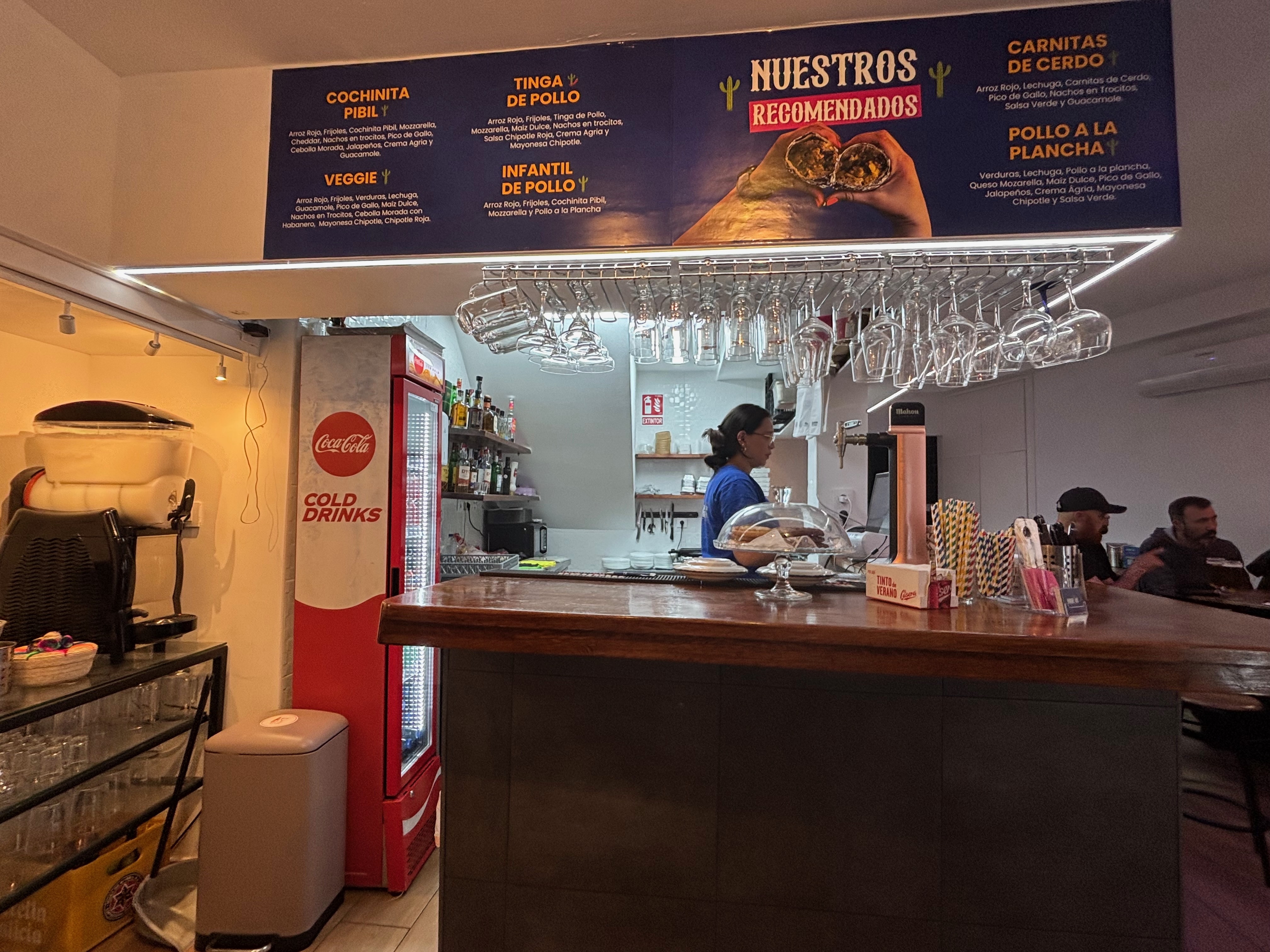
We walked up Calle Juan Bravo, past the small plaza where we’d encountered the police officers and entered Plaza Mayor, the city’s main gathering spot. As with Salamanca, an exhibition was being set up and we decided to see if we could find an inexpensive option for our meal, which we found after searching the blocks around the Plaza at Burritos by Rosa Mexicano.
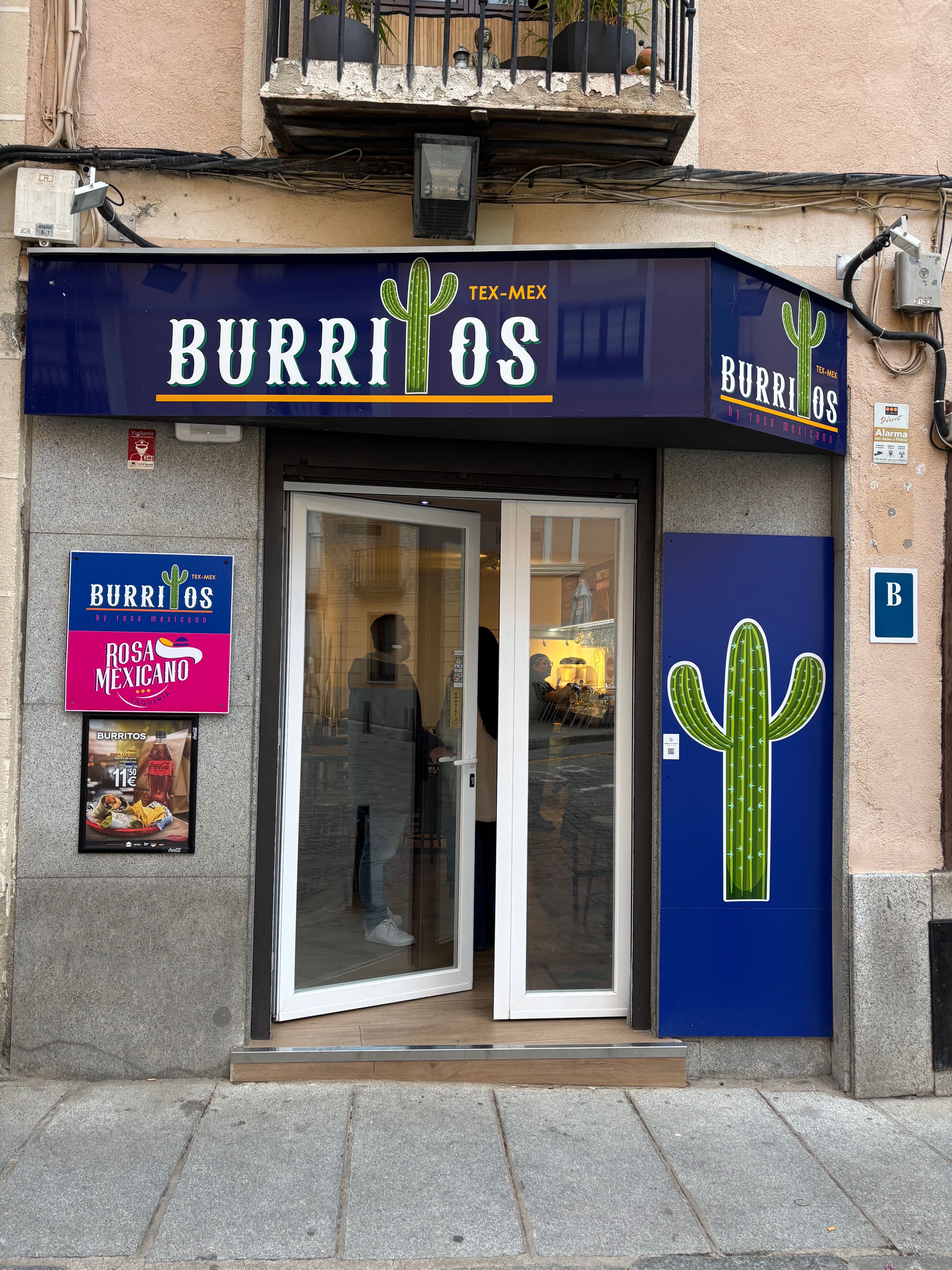
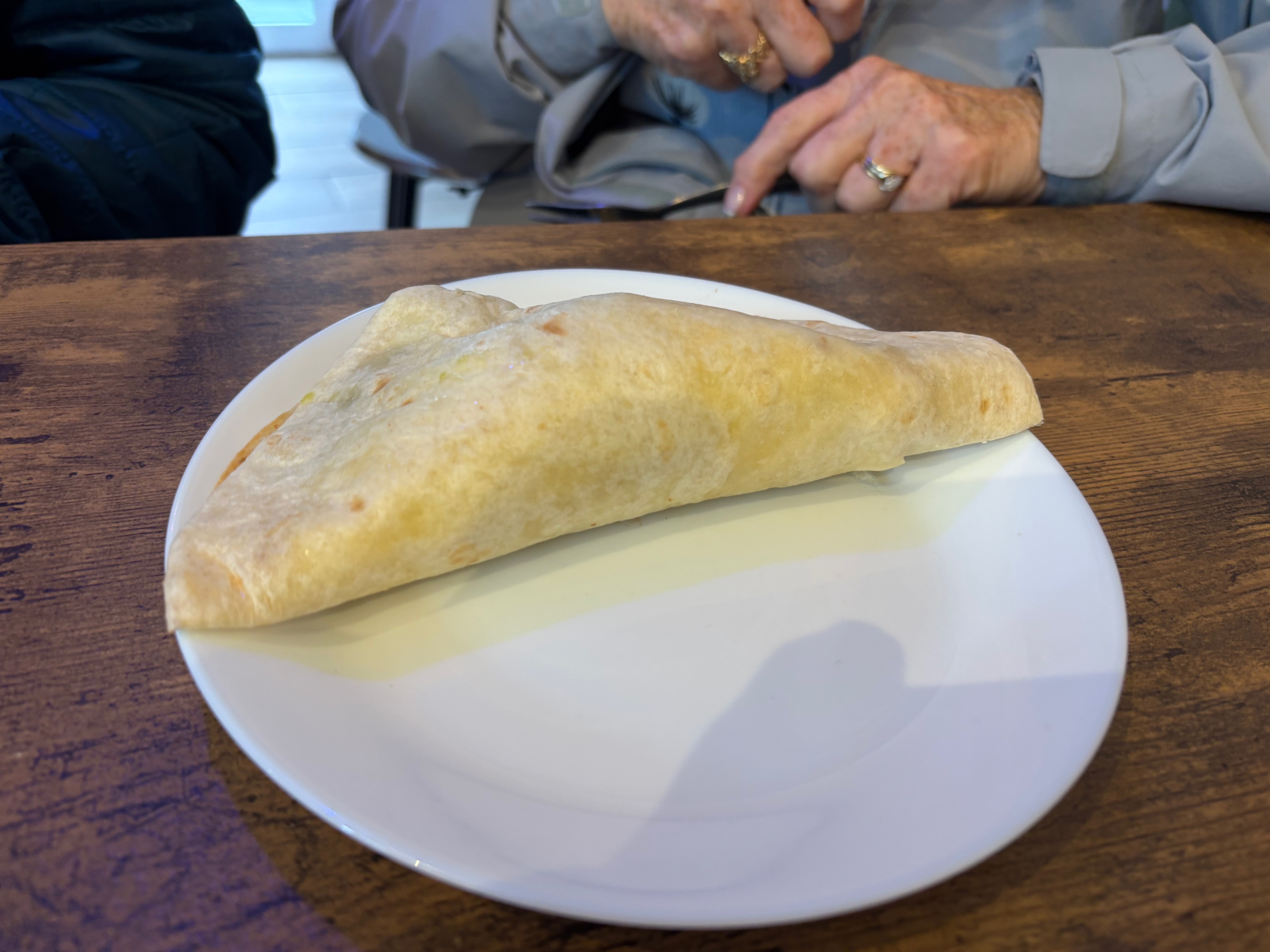
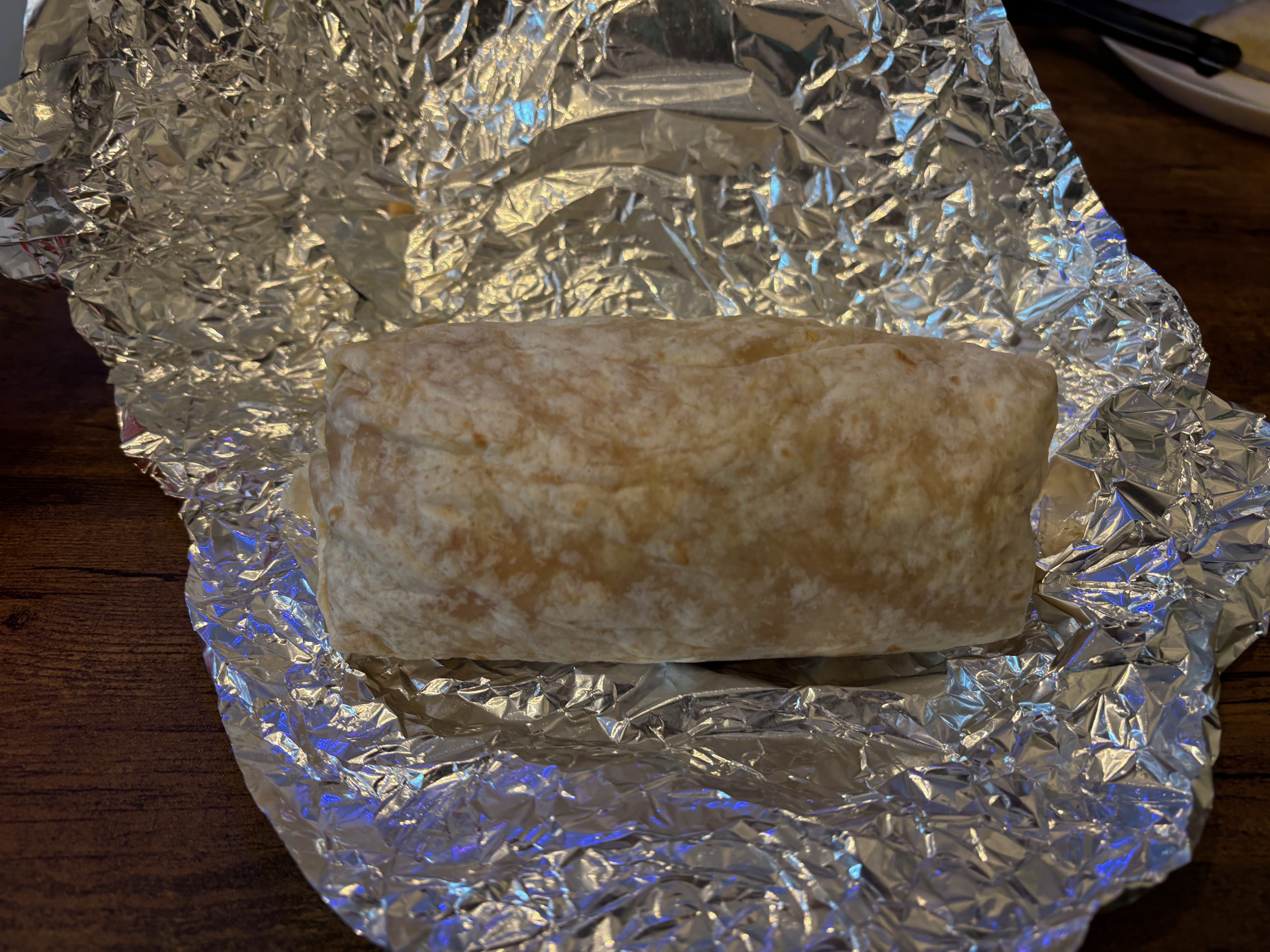
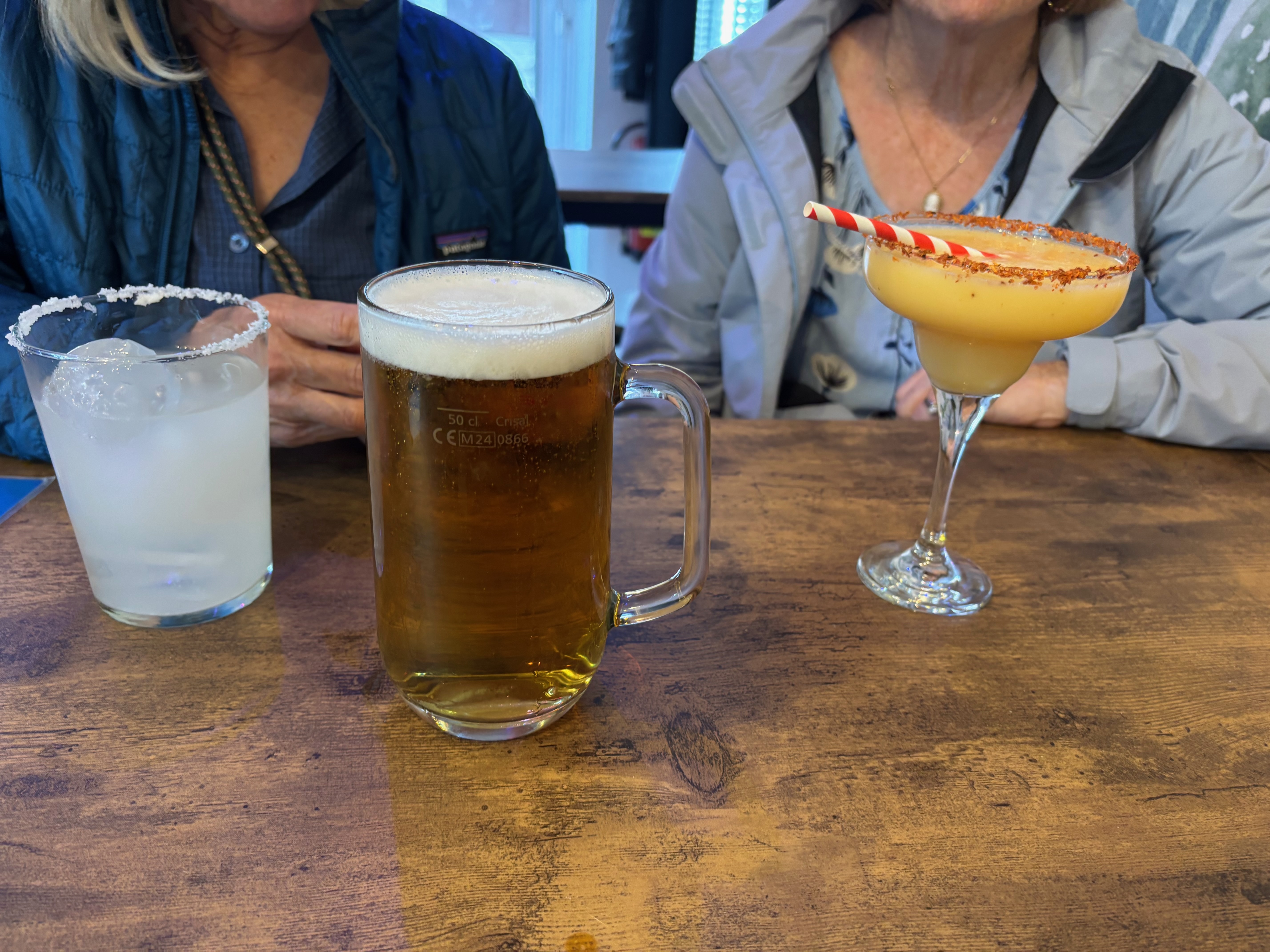
This would turn out to be a good choice, as it was reasonably priced and quite good Mexican food, comparable to what we might get at home. I ordered a beer while Joanna and Bev had Margaritas, a limon and Mango, respectively. Joanna had a very good Cochinita Pibil Quesadilla, while Bev and I devoured our Carnitas burritos. Hearty and satisfying, our tab came to 40 Euros ($45.30) for the three of us, just $15 apiece including alcohol.
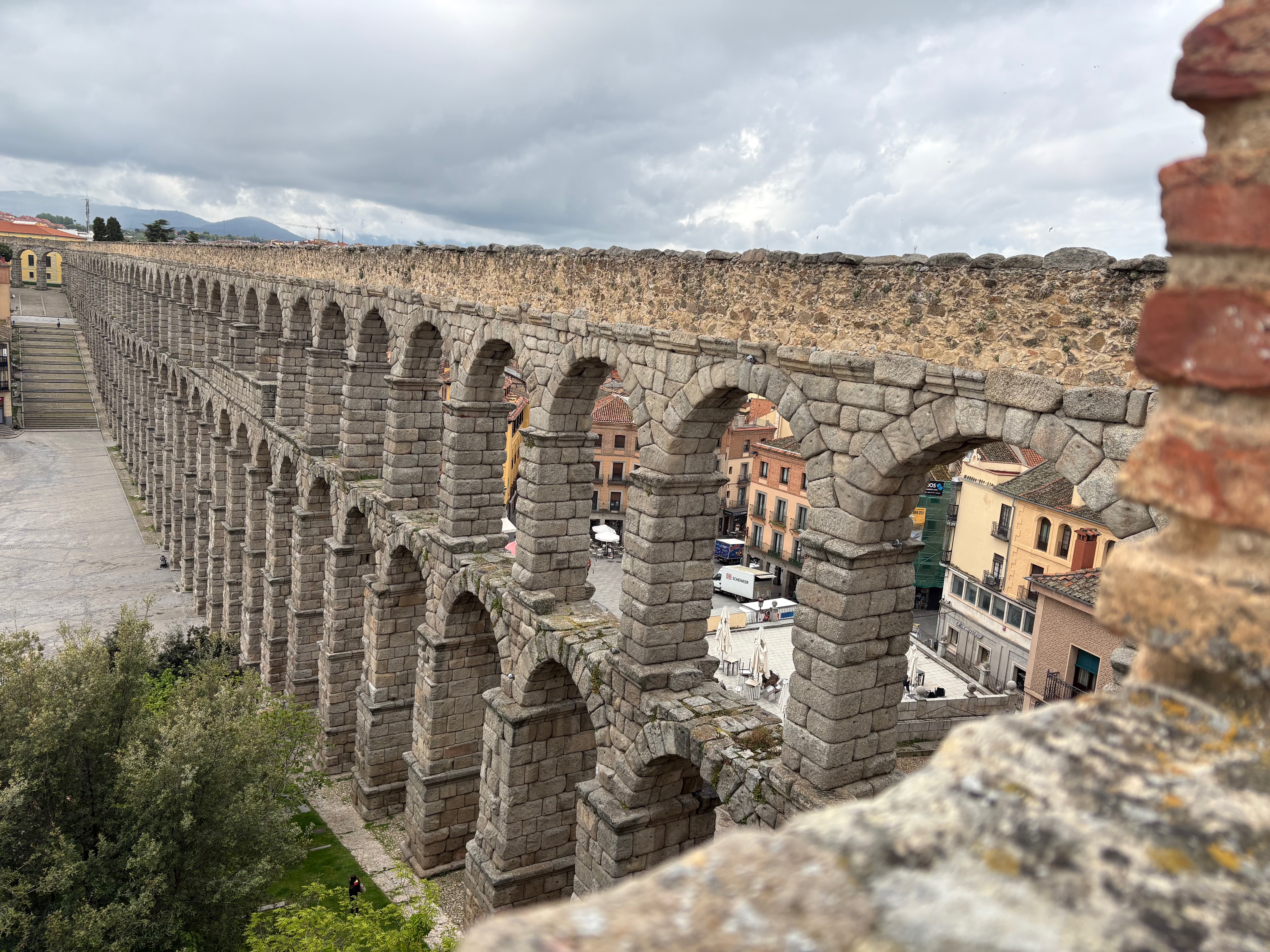
The next morning, we set out to do the St. Steves walking tour, which took us on Calle Juan Bravo downhill, bending onto Calle de Cervates, to one of Segovia’s highlights, Plaza del Azogüejo and the Roman Aqueduct, with the plaza dominated by the 2,000-year-old acueducto romano. Ancient Segovia was approximately the same size as today’s city, with some 50,000 inhabitants, including soldiers at a military base, all of whom needed a reliable water supply. The first century AD Roman Emperor at the time, Trajan’s engineers built a nine-mile aqueduct to channel water from the Río Frío to the city, culminating at the Roman castle (today’s Alcázar).
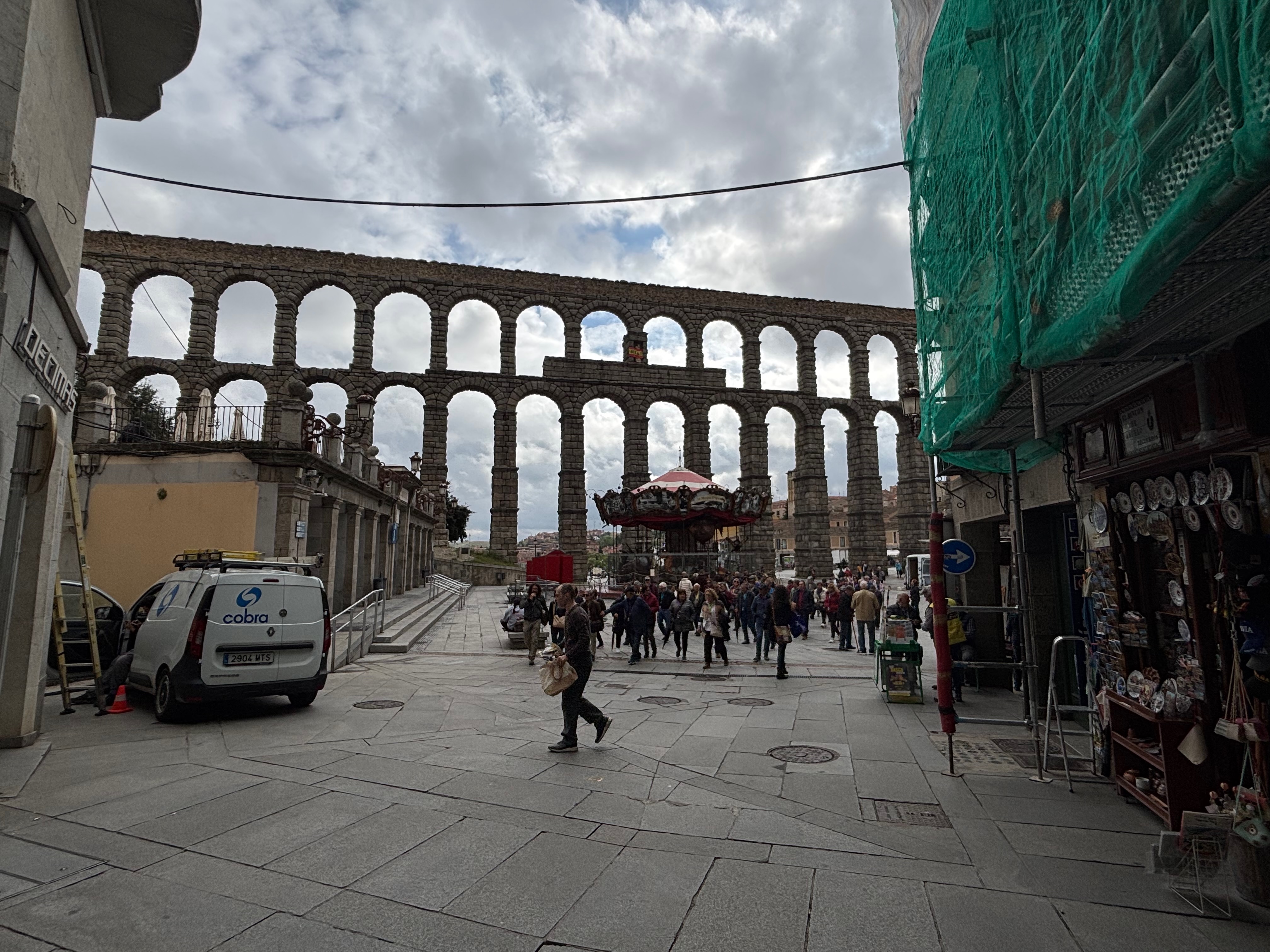
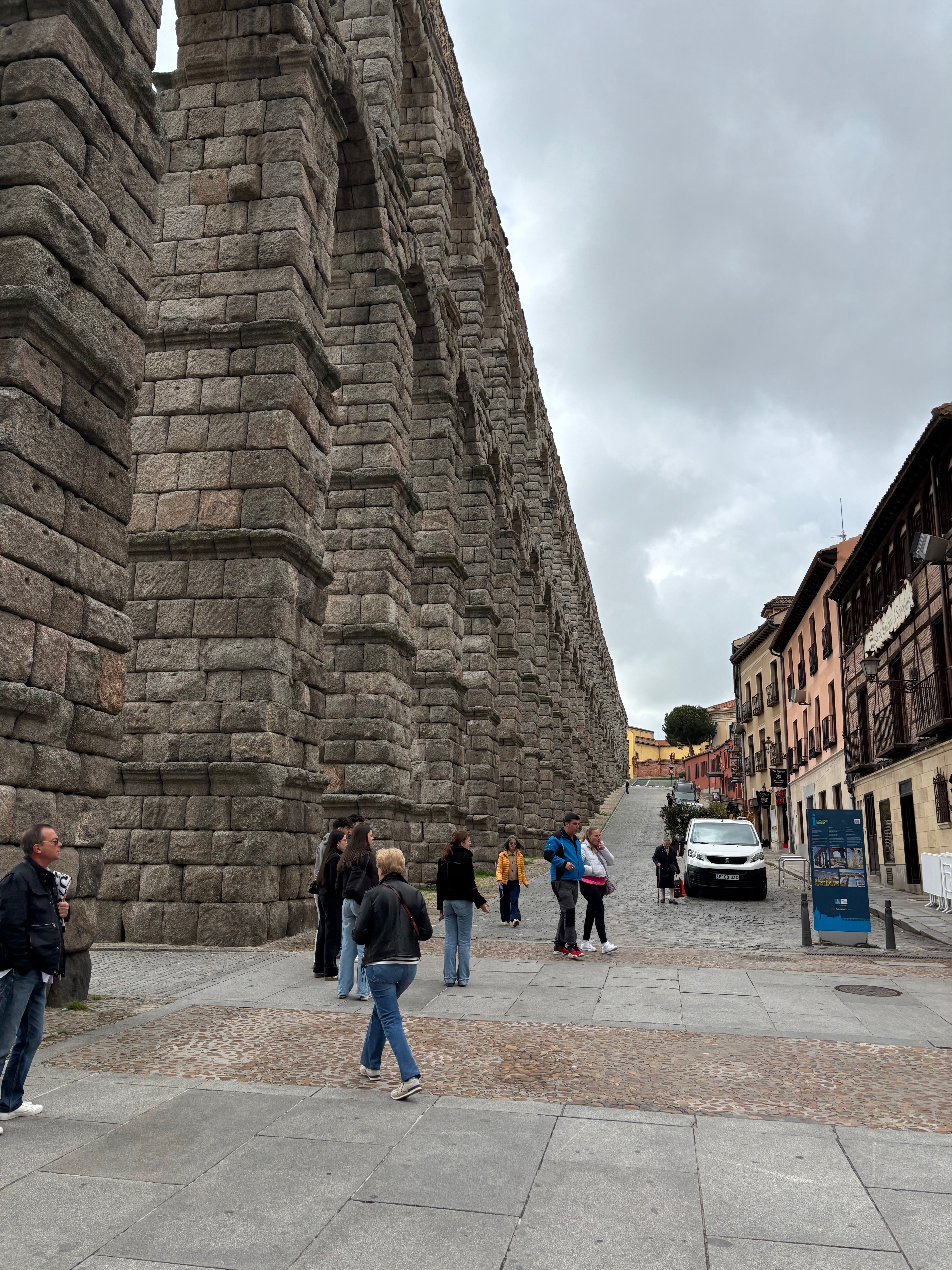
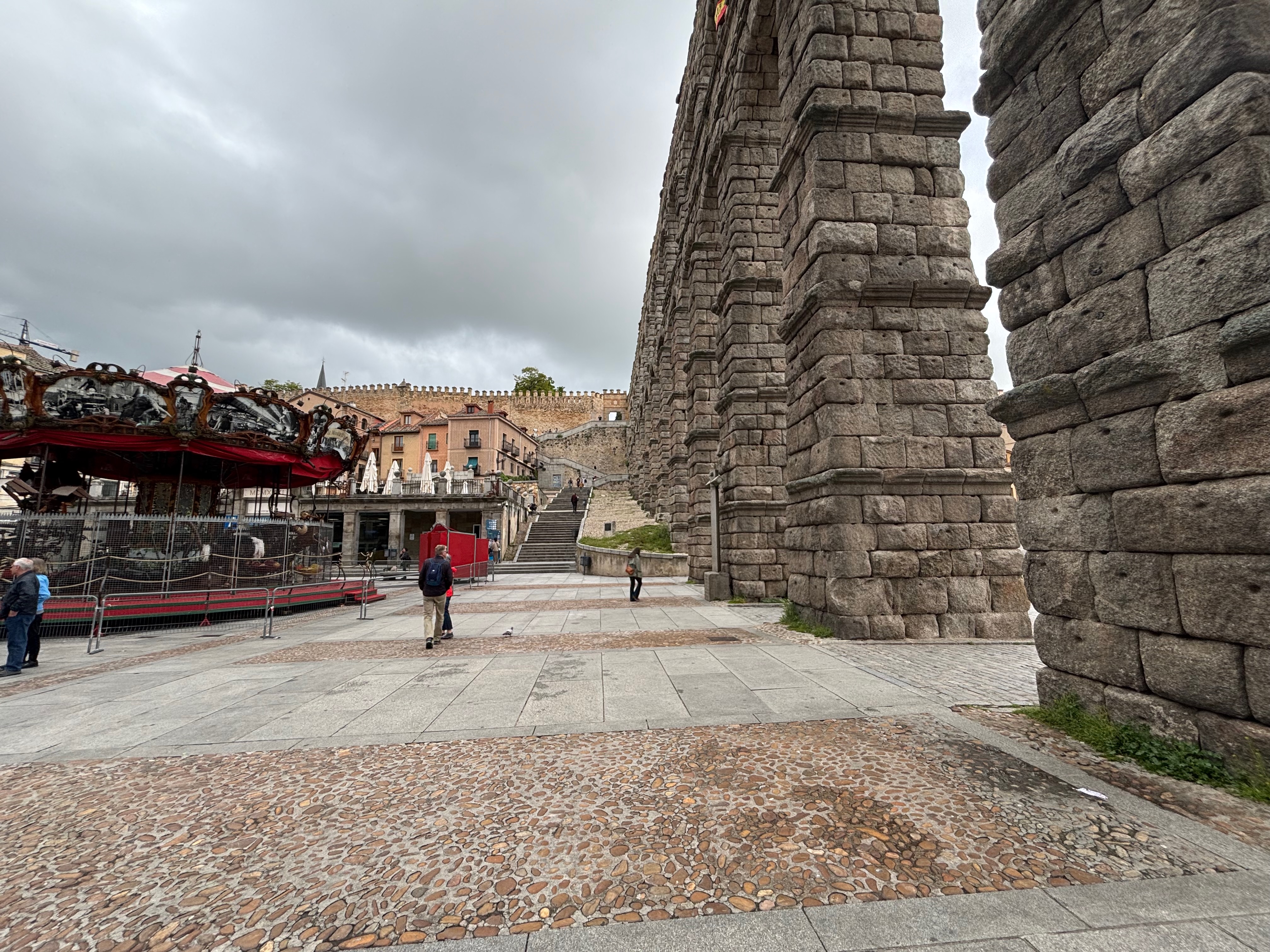
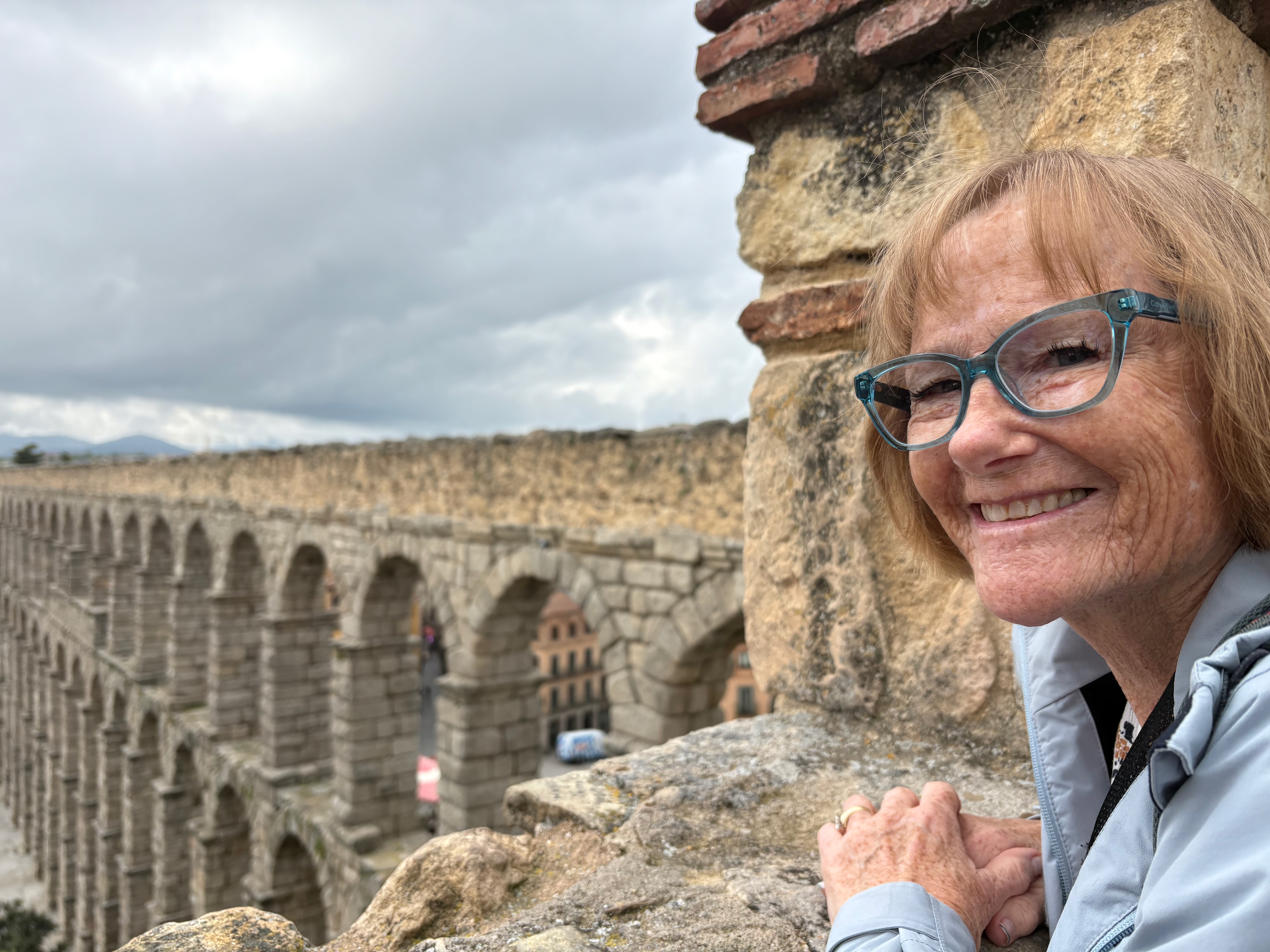
Though most of that conduit was underground, this elegant, double-arched bridge was needed to keep the water flowing evenly across this stretch of valley. It is an impressive structure: 2,500 feet long and 100 feet high, with 118 arches, made from 24,000 granite blocks without any mortar, and still carrying a stream of water to this day. While Joanna and Bev walked up a steep series of steps to get a view from the top, I grabbed a Café con Leche and a small snack at a nearby café and waited for their return.
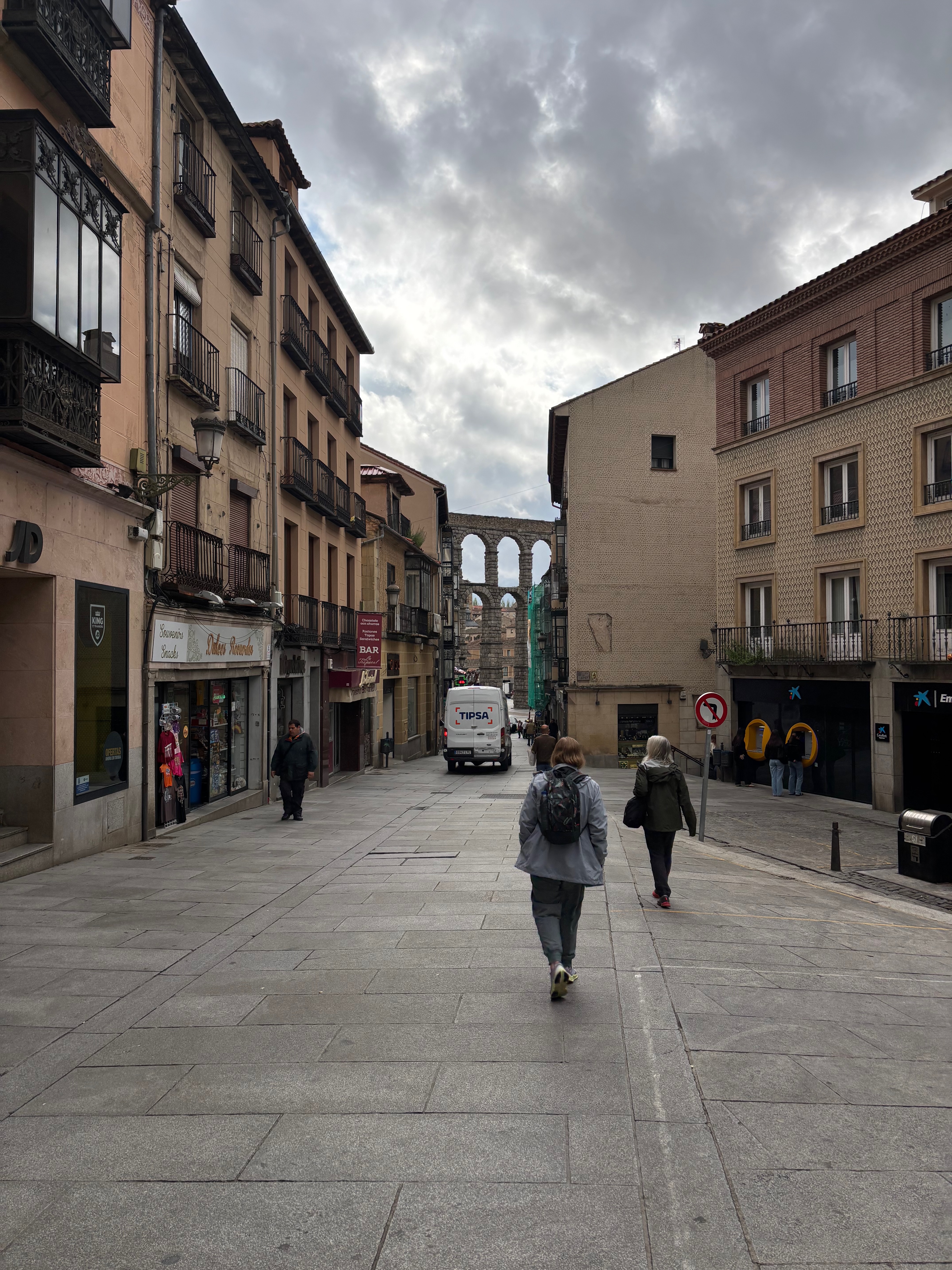
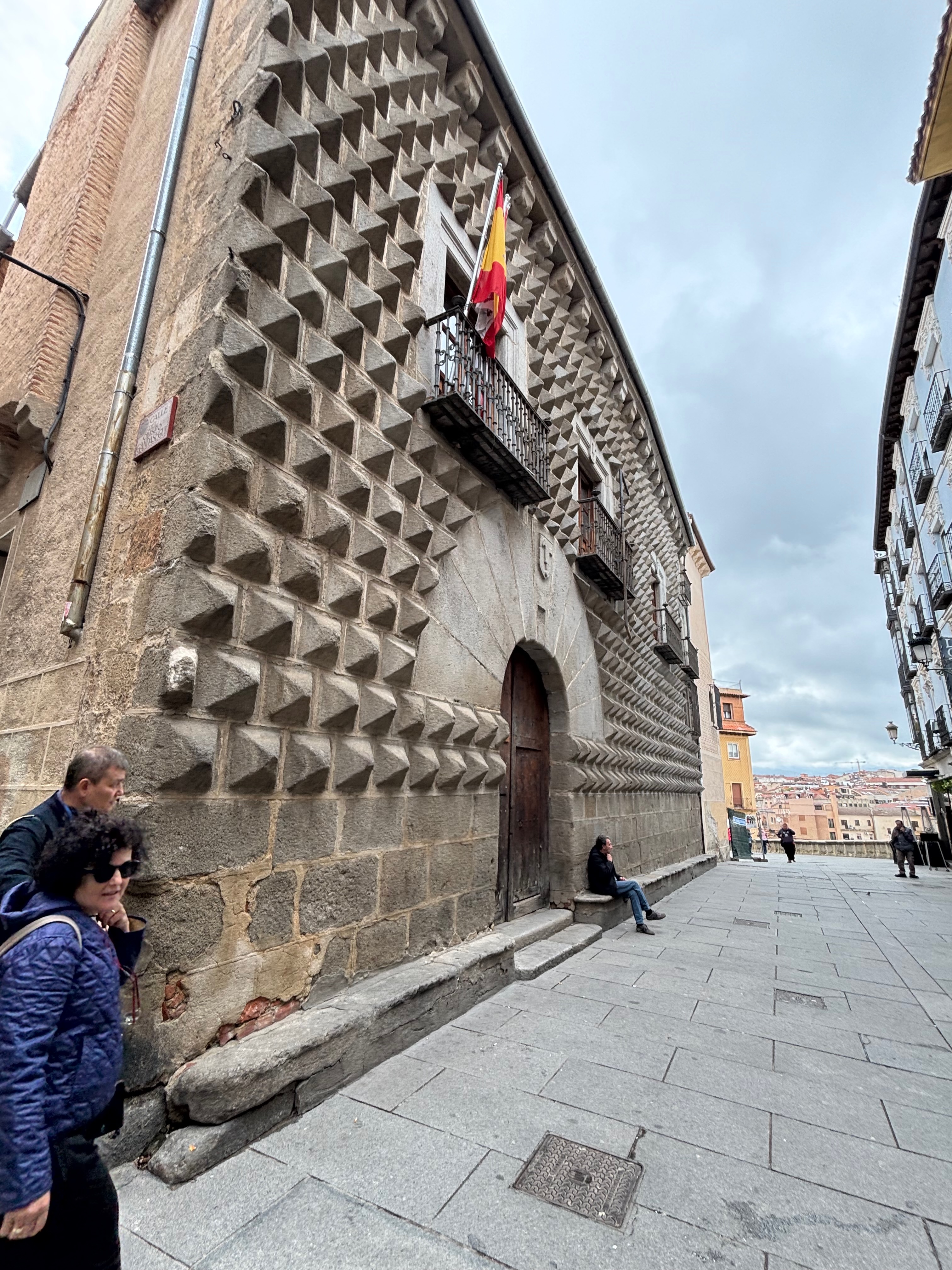
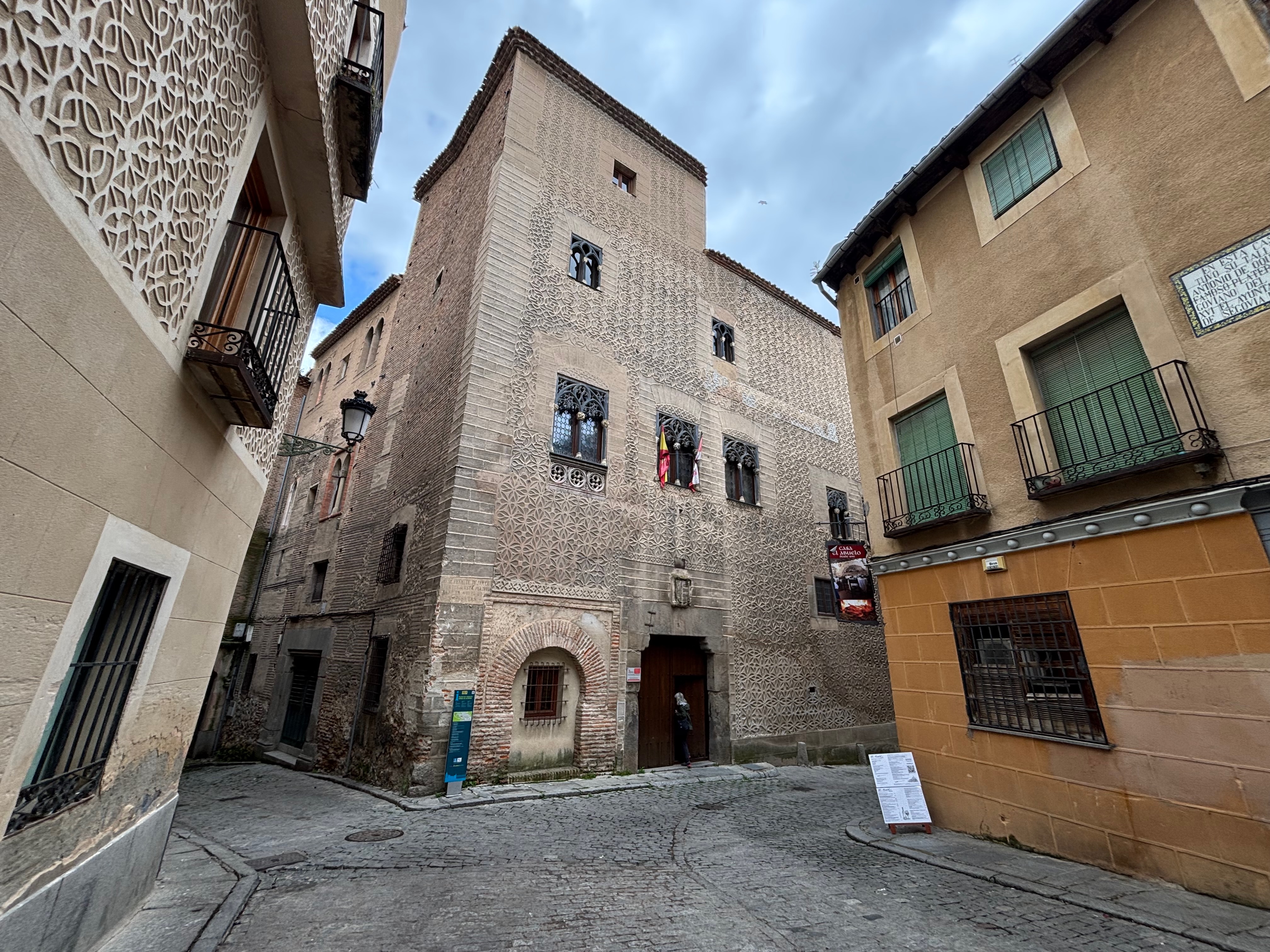
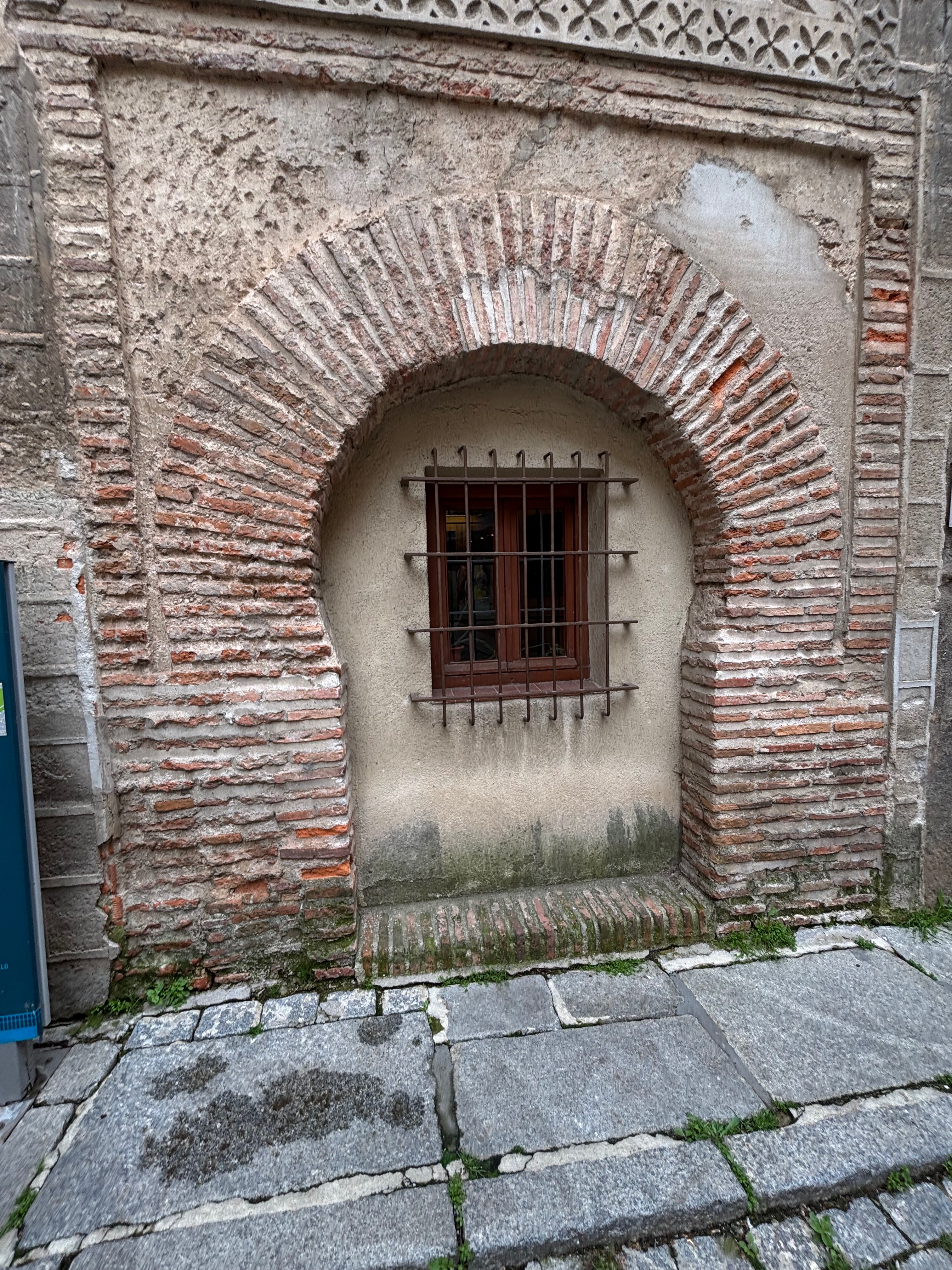
Upon when they did, we started back uphill on Calle de Cervantes, also known as the Calle Real, the “Royal Street” because it leads, eventually, to the Alcázar. Along the way we stopped briefly at the “house of a thousand beaks” (Casa de los Picos) whose original Moorish design is still easy to see. Continuing we again make the turn onto Calle Juan Bravo and stopped in Plaza del Platero Oquendo where sits the Palacio de Cascales, another example of a once-fortified, now-softened house with a cropped tower. Here, the brick horseshoe arch, an example of Mudejar-style architecture, reflects the influence of Moorish artisans working for Christians.
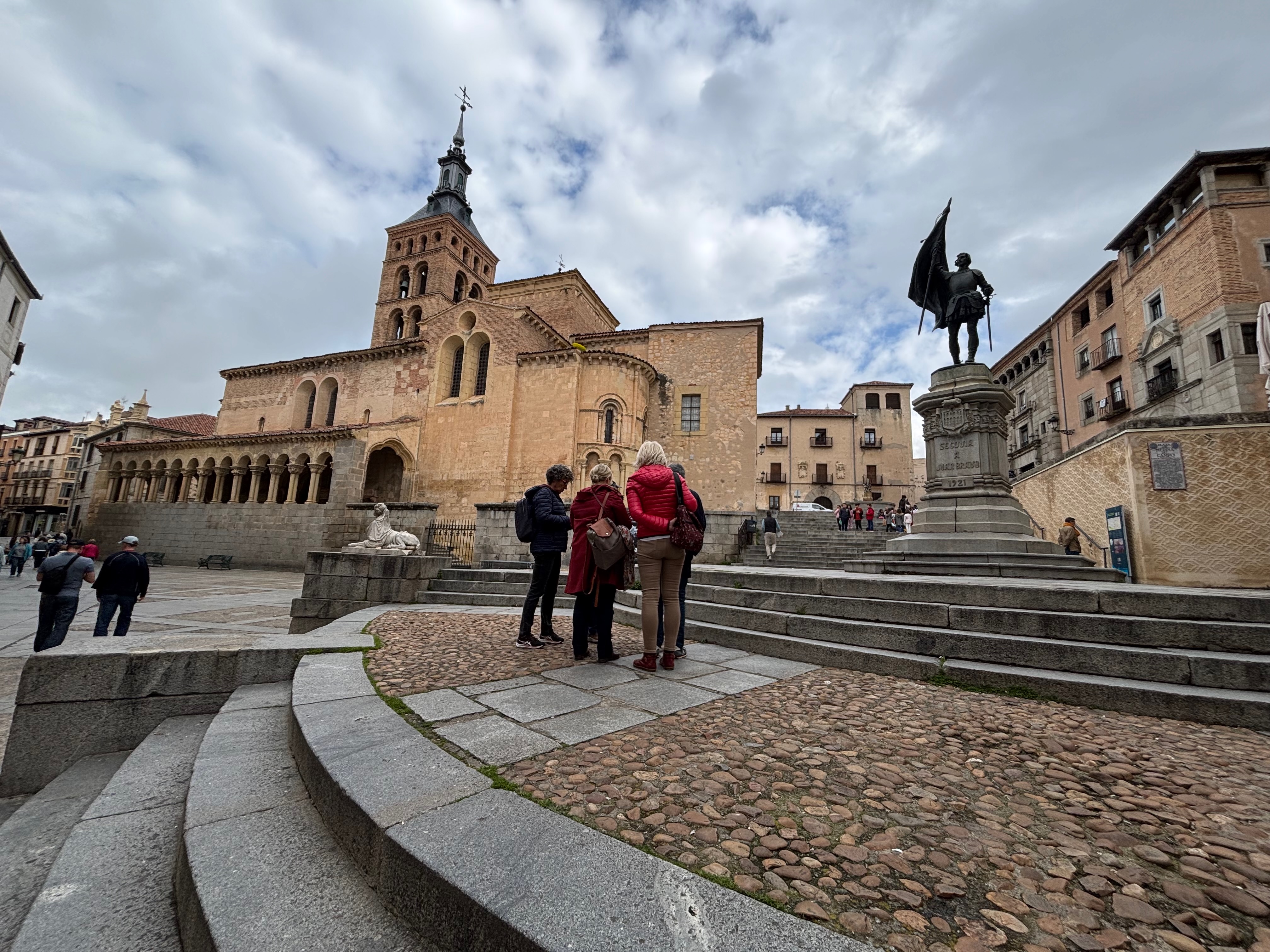
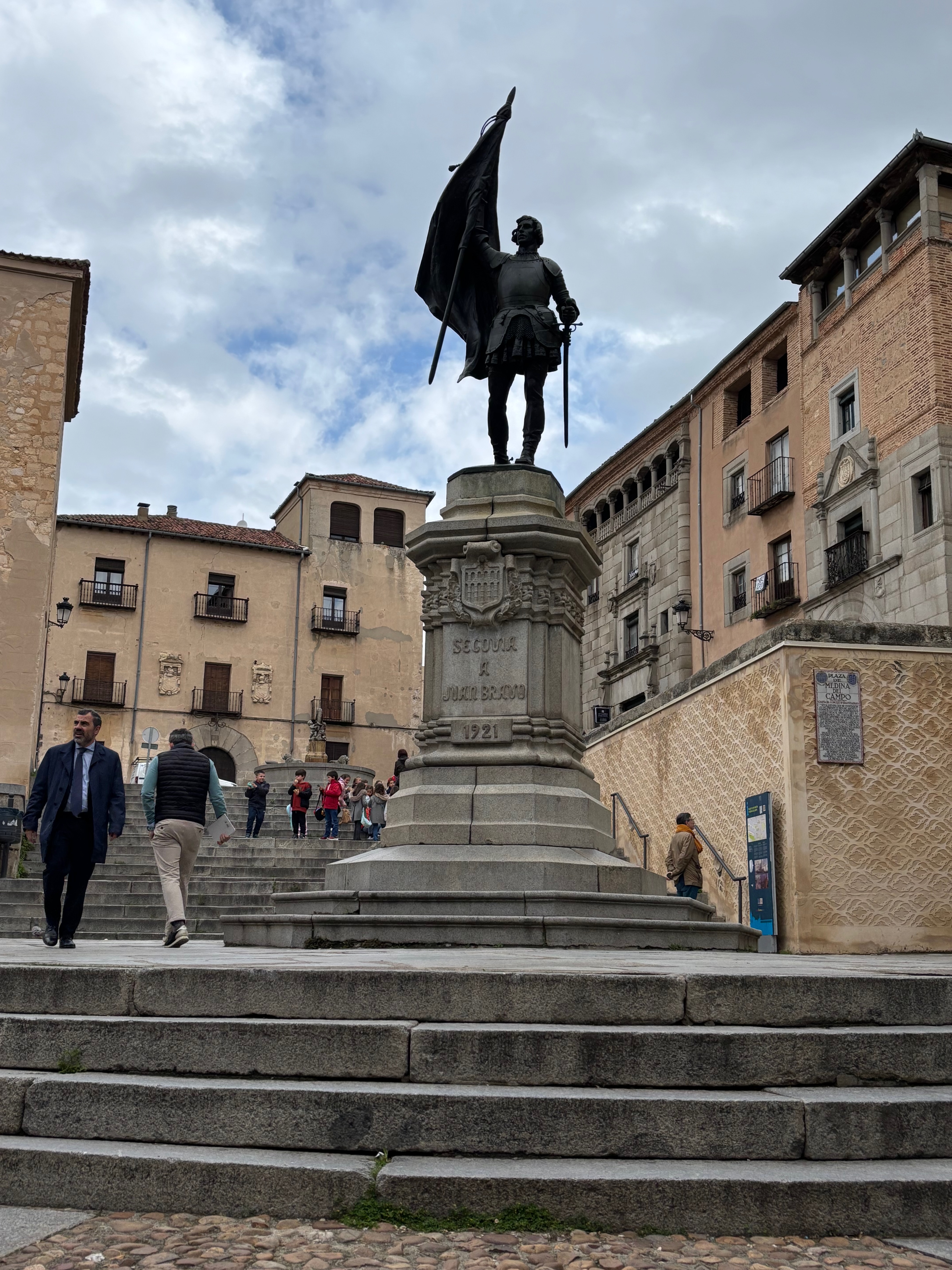
Our next stop was at Plaza de San Martin, home to our hotel, the 12th-century Church of St. Martín, built as Christians were reinhabiting the formerly Islamic city and the statue commemorating Juan Bravo. When Spain’s King Charles V, a Habsburg who didn’t even speak Spanish, took power, he imposed his rule over Castile. This threatened the local nobles, who, inspired and led by Juan Bravo, revolted in 1521 and Bravo, who lost the battle and his head, is still a symbol of Castilian pride. This statue was erected in 1921 on the 400th anniversary of his death.
We will leave the tour here, just before we stopped in Plaza Mayor for a mid-morning pick me up and continue it in our next post.
Links
Hotel Real Segovia: https://www.recordishotels.com/es/hotel-real-segovia/
Burritos by Rosa Mexicano: https://rosamexicanotaqueria.com/burritos/
Europe 2025 – Segovia, Part One
May 8 – 9
Our drive to Segovia would be another short one, but with nothing much to see on the way we stayed at the condo until check out time which would get us to our hotel right around check in time. The drive went well until we reached town and then we hit one of those driving nightmares that make for a funny story afterwards. It was all on me as I’d failed to dive deep enough at the hotel’s web site to note that they gave a different address for those driving in as opposed to those using public transportation as the hotel was smack dab in the middle of the old town.
The GPS did as it is supposed to, guiding us to the hotel’s walk in address which led us to continually narrowing streets, one where we had to move tables outside a restaurant in order to pass through, eventually landing us at a broad plaza where it became obvious that the car shouldn’t be where it was. We sent Joanna ahead on foot to the hotel, a couple of blocks away to determine our best course of action and in the meantime two local police officers approached the car and we began to dialogue.
One, the guy, spoke passable English and the other, a woman, didn’t and she because of this, she appeared to want to arrest us on the spot. Between my rudimentary Spanish and his English, we determined, obviously, that I wasn’t supposed to be there and he eventually directed me to a street one block away that I could turn onto and escape our dilemma. Around this time Joanna rejoined us with the correct address which would turn out to be right on the street we’d used to exit the plaza.
Not knowing this, we ended up completely circling the town again and finally reaching the correct address where we parked and walked the block or so to Hotel Real Segovia, a St. Steves recommendation which we’d chosen as there were no reasonable or nicely located Airbnb’s available. Once we landed there, appreciated its location and ambience, as the guidebook describes it as a “classic hotel (quick to brag about the many old-time movie stars who stayed here). They rent 37 beautifully updated rooms with all the modern amenities right along the main drag, between the aqueduct and Plaza Mayor. In spite of its central location, many of its rooms face the quiet countryside.”
Check in went smoothly and they sent someone to fetch and park the car, a welcome relief and after settling into our shared room with Bev, which ran us 367 Euros ($376) for the two nights , including parking, we hit the streets to check out the neighborhood, where we located a small market for supplies and then returned to our room to relax with drinks before heading out for dinner.
We walked up Calle Juan Bravo, past the small plaza where we’d encountered the police officers and entered Plaza Mayor, the city’s main gathering spot. As with Salamanca, an exhibition was being set up and we decided to see if we could find an inexpensive option for our meal, which we found after searching the blocks around the Plaza at Burritos by Rosa Mexicano.
This would turn out to be a good choice, as it was reasonably priced and quite good Mexican food, comparable to what we might get at home. I ordered a beer while Joanna and Bev had Margaritas, a limon and Mango, respectively. Joanna had a very good Cochinita Pibil Quesadilla, while Bev and I devoured our Carnitas burritos. Hearty and satisfying, our tab came to 40 Euros ($45.30) for the three of us, just $15 apiece including alcohol.
The next morning, we set out to do the St. Steves walking tour, which took us on Calle Juan Bravo downhill, bending onto Calle de Cervates, to one of Segovia’s highlights, Plaza del Azogüejo and the Roman Aqueduct, with the plaza dominated by the 2,000-year-old acueducto romano. Ancient Segovia was approximately the same size as today’s city, with some 50,000 inhabitants, including soldiers at a military base, all of whom needed a reliable water supply. The first century AD Roman Emperor at the time, Trajan’s engineers built a nine-mile aqueduct to channel water from the Río Frío to the city, culminating at the Roman castle (today’s Alcázar).
Though most of that conduit was underground, this elegant, double-arched bridge was needed to keep the water flowing evenly across this stretch of valley. It is an impressive structure: 2,500 feet long and 100 feet high, with 118 arches, made from 24,000 granite blocks without any mortar, and still carrying a stream of water to this day. While Joanna and Bev walked up a steep series of steps to get a view from the top, I grabbed a Café con Leche and a small snack at a nearby café and waited for their return.
Upon when they did, we started back uphill on Calle de Cervantes, also known as the Calle Real, the “Royal Street” because it leads, eventually, to the Alcázar. Along the way we stopped briefly at the “house of a thousand beaks” (Casa de los Picos) whose original Moorish design is still easy to see. Continuing we again make the turn onto Calle Juan Bravo and stopped in Plaza del Platero Oquendo where sits the Palacio de Cascales, another example of a once-fortified, now-softened house with a cropped tower. Here, the brick horseshoe arch, an example of Mudejar-style architecture, reflects the influence of Moorish artisans working for Christians.
Our next stop was at Plaza de San Martin, home to our hotel, the 12th-century Church of St. Martín, built as Christians were reinhabiting the formerly Islamic city and the statue commemorating Juan Bravo. When Spain’s King Charles V, a Habsburg who didn’t even speak Spanish, took power, he imposed his rule over Castile. This threatened the local nobles, who, inspired and led by Juan Bravo, revolted in 1521 and Bravo, who lost the battle and his head, is still a symbol of Castilian pride. This statue was erected in 1921 on the 400th anniversary of his death.
We will leave the tour here, just before we stopped in Plaza Mayor for a mid-morning pick me up and continue it in our next post.
Links
Hotel Real Segovia: https://www.recordishotels.com/es/hotel-real-segovia/
Burritos by Rosa Mexicano: https://rosamexicanotaqueria.com/burritos/
Blog Post 1-11-2026
Europe 2025 – Segovia, Part One
May 8 – 9
Our drive to Segovia would be another short one, but with nothing much to see on the way we stayed at the condo until check out time which would get us to our hotel right around check in time. The drive went well until we reached town and then we hit one of those driving nightmares that make for a funny story afterwards. It was all on me as I’d failed to dive deep enough at the hotel’s web site to note that they gave a different address for those driving in as opposed to those using public transportation as the hotel was smack dab in the middle of the old town.
The GPS did as it is supposed to, guiding us to the hotel’s walk in address which led us to continually narrowing streets, one where we had to move tables outside a restaurant in order to pass through, eventually landing us at a broad plaza where it became obvious that the car shouldn’t be where it was. We sent Joanna ahead on foot to the hotel, a couple of blocks away to determine our best course of action and in the meantime two local police officers approached the car and we began to dialogue.
One, the guy, spoke passable English and the other, a woman, didn’t and she because of this, she appeared to want to arrest us on the spot. Between my rudimentary Spanish and his English, we determined, obviously, that I wasn’t supposed to be there and he eventually directed me to a street one block away that I could turn onto and escape our dilemma. Around this time Joanna rejoined us with the correct address which would turn out to be right on the street we’d used to exit the plaza.
Not knowing this, we ended up completely circling the town again and finally reaching the correct address where we parked and walked the block or so to Hotel Real Segovia, a St. Steves recommendation which we’d chosen as there were no reasonable or nicely located Airbnb’s available. Once we landed there, appreciated its location and ambience, as the guidebook describes it as a “classic hotel (quick to brag about the many old-time movie stars who stayed here). They rent 37 beautifully updated rooms with all the modern amenities right along the main drag, between the aqueduct and Plaza Mayor. In spite of its central location, many of its rooms face the quiet countryside.”
Check in went smoothly and they sent someone to fetch and park the car, a welcome relief and after settling into our shared room with Bev, which ran us 367 Euros ($376) for the two nights , including parking, we hit the streets to check out the neighborhood, where we located a small market for supplies and then returned to our room to relax with drinks before heading out for dinner.
We walked up Calle Juan Bravo, past the small plaza where we’d encountered the police officers and entered Plaza Mayor, the city’s main gathering spot. As with Salamanca, an exhibition was being set up and we decided to see if we could find an inexpensive option for our meal, which we found after searching the blocks around the Plaza at Burritos by Rosa Mexicano.
This would turn out to be a good choice, as it was reasonably priced and quite good Mexican food, comparable to what we might get at home. I ordered a beer while Joanna and Bev had Margaritas, a limon and Mango, respectively. Joanna had a very good Cochinita Pibil Quesadilla, while Bev and I devoured our Carnitas burritos. Hearty and satisfying, our tab came to 40 Euros ($45.30) for the three of us, just $15 apiece including alcohol.
The next morning, we set out to do the St. Steves walking tour, which took us on Calle Juan Bravo downhill, bending onto Calle de Cervates, to one of Segovia’s highlights, Plaza del Azogüejo and the Roman Aqueduct, with the plaza dominated by the 2,000-year-old acueducto romano. Ancient Segovia was approximately the same size as today’s city, with some 50,000 inhabitants, including soldiers at a military base, all of whom needed a reliable water supply. The first century AD Roman Emperor at the time, Trajan’s engineers built a nine-mile aqueduct to channel water from the Río Frío to the city, culminating at the Roman castle (today’s Alcázar).
Though most of that conduit was underground, this elegant, double-arched bridge was needed to keep the water flowing evenly across this stretch of valley. It is an impressive structure: 2,500 feet long and 100 feet high, with 118 arches, made from 24,000 granite blocks without any mortar, and still carrying a stream of water to this day. While Joanna and Bev walked up a steep series of steps to get a view from the top, I grabbed a Café con Leche and a small snack at a nearby café and waited for their return.
Upon when they did, we started back uphill on Calle de Cervantes, also known as the Calle Real, the “Royal Street” because it leads, eventually, to the Alcázar. Along the way we stopped briefly at the “house of a thousand beaks” (Casa de los Picos) whose original Moorish design is still easy to see. Continuing we again make the turn onto Calle Juan Bravo and stopped in Plaza del Platero Oquendo where sits the Palacio de Cascales, another example of a once-fortified, now-softened house with a cropped tower. Here, the brick horseshoe arch, an example of Mudejar-style architecture, reflects the influence of Moorish artisans working for Christians.
Our next stop was at Plaza de San Martin, home to our hotel, the 12th-century Church of St. Martín, built as Christians were reinhabiting the formerly Islamic city and the statue commemorating Juan Bravo. When Spain’s King Charles V, a Habsburg who didn’t even speak Spanish, took power, he imposed his rule over Castile. This threatened the local nobles, who, inspired and led by Juan Bravo, revolted in 1521 and Bravo, who lost the battle and his head, is still a symbol of Castilian pride. This statue was erected in 1921 on the 400th anniversary of his death.
We will leave the tour here, just before we stopped in Plaza Mayor for a mid-morning pick me up and continue it in our next post.
Links
Hotel Real Segovia: https://www.recordishotels.com/es/hotel-real-segovia/
Burritos by Rosa Mexicano: https://rosamexicanotaqueria.com/burritos/
Discover more from 3jmann
Subscribe to get the latest posts sent to your email.


 3jmann